

Essential oil blending ratios define the proportions of top, middle, and base note oils combined to create a balanced, aromatic, and skin-safe blend. The industry-standard framework is the 30-50-20 rule, which calls for 30% top notes, 50% middle notes, and 20% base notes in any blend. This proportion guide applies whether you are making a 10-drop test blend or scaling up to a full bottle. Getting these ratios right matters for two reasons: aroma balance and safety, especially when applying oils directly to skin. This essential oil blending ratios guide covers everything from note classification to dilution math so you can blend with confidence from day one.
What are essential oil notes and why do they matter?
Every oil in aromatherapy blending falls into one of three note categories based on how quickly it evaporates. Evaporation rates determine how a blend smells when you first apply it, how it develops over the next hour, and what lingers on your skin by the end of the day. Understanding notes is the foundation of any oil blend recipe.
| Note | Evaporation Time | Common Examples | Role in Blend |
|---|---|---|---|
| Top | 0.5–3 hours | Lemon, Bergamot, Peppermint | First impression, bright opening |
| Middle | 2–4 hours | Lavender, Geranium, Rosemary | Heart of the blend, body and balance |
| Base | Several days | Sandalwood, Cedarwood, Vetiver | Depth, fixative, lasting warmth |
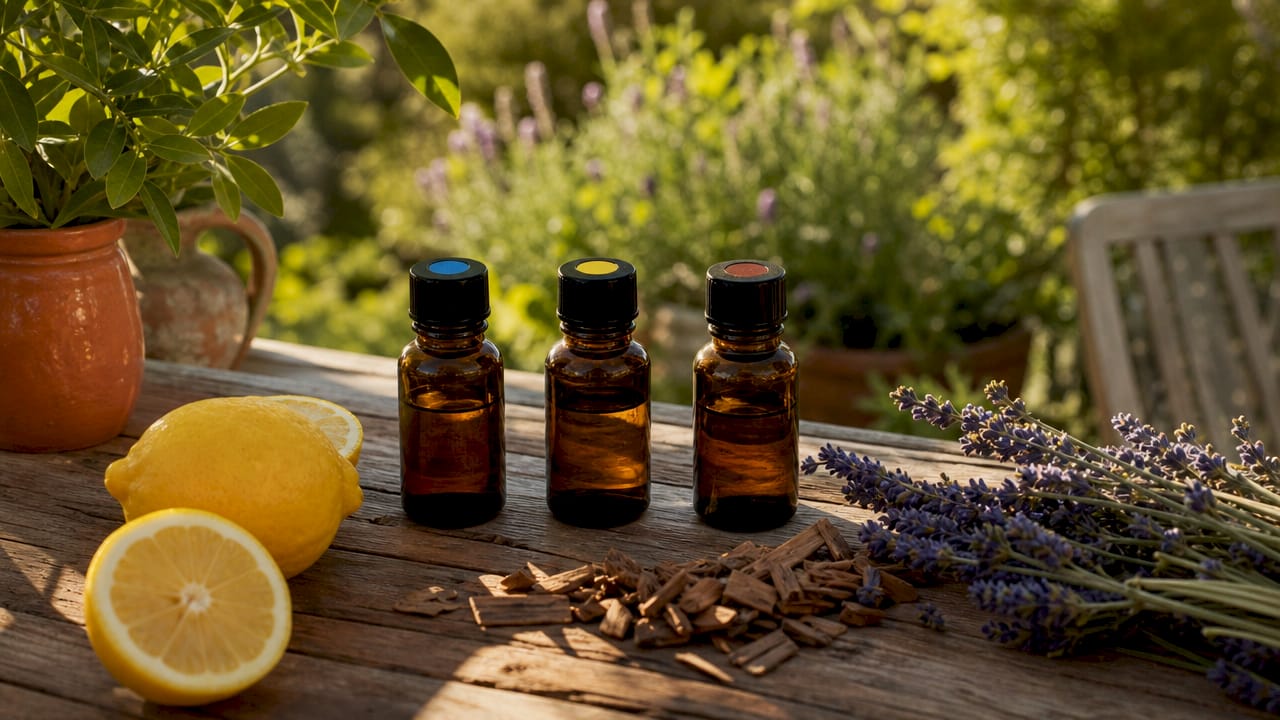
Top notes hit your nose first. They are bright, sharp, and often citrus-based, but they fade fastest. Middle notes form the core character of a blend. Lavender and Geranium are classic examples because they are versatile and blend well with almost anything. Base notes are the anchor. Sandalwood and Cedarwood evaporate slowly, which means they extend the life of the entire blend on your skin.
A blend without base notes disappears within the hour. A blend without top notes smells heavy and flat from the start. The 30-50-20 ratio exists because middle notes carry the most aromatic weight, top notes provide the opening, and base notes provide staying power. Each category earns its proportion.
How to calculate and apply essential oil blending ratios
The 30-50-20 ratio translates directly into drop counts. For a 10-drop blend, you use 3 drops of top notes, 5 drops of middle notes, and 2 drops of base notes. That is your starting formula for any oil blend recipe.
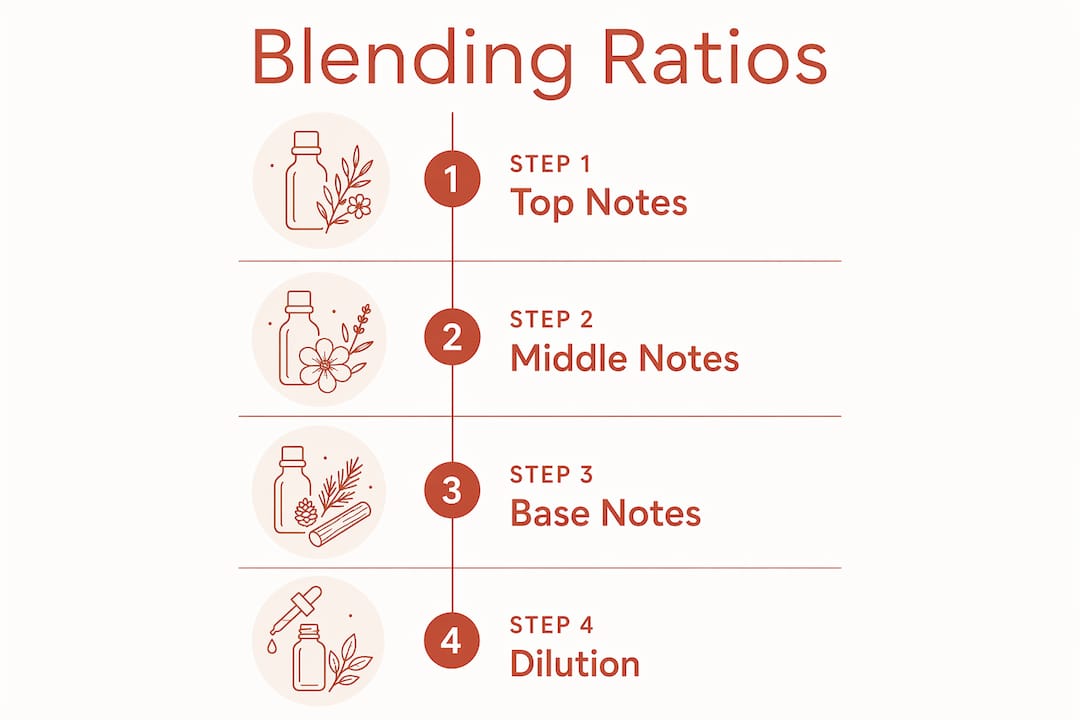
Scaling up is straightforward when you think in parts rather than fixed drops. The parts system works like this: 3 parts top, 5 parts middle, 2 parts base. For a 100-drop batch, that becomes 30 drops top, 50 drops middle, and 20 drops base. The aroma balance stays identical regardless of batch size.
Here is a practical example of two mood-based blends using the 30-50-20 formula:
-
Daytime uplift blend (10 drops total)
- 3 drops Lemon (top)
- 5 drops Rosemary (middle)
- 2 drops Cedarwood (base)
-
Evening relaxation blend (10 drops total)
- 3 drops Bergamot (top)
- 5 drops Lavender (middle)
- 2 drops Sandalwood (base)
Both follow the same ratio. The mood changes entirely based on which oils fill each note slot. This is the power of the proportion guide: the structure stays fixed while the creative choices remain yours.
You do not have to stick rigidly to 30-50-20 forever. Some blenders prefer a 20-60-20 split for floral-heavy blends or a 40-40-20 split for fresh, citrus-forward profiles. The key is that base notes rarely exceed 20-30% because their intensity can overpower everything else.
Pro Tip: Start with three oils, one from each note category, before adding complexity. More than five oils in a single blend makes it harder to identify what is working and what is not.
What are safe dilution ratios for topical essential oil blends?
Dilution is not optional when applying essential oils to skin. Pure essential oils are highly concentrated plant extracts, and applying them undiluted causes irritation, sensitization, and in some cases chemical burns. The safe dilution range for adults is 0.5% to 3%, depending on the application and the person.
The math converts simply into drops per 30 mL (1 fluid ounce) of carrier oil:
- 0.5% dilution: 3 drops per 30 mL (for daily facial use or sensitive skin)
- 1% dilution: 6 drops per 30 mL (for children, elderly, or long-term daily use)
- 2% dilution: 12 drops per 30 mL (standard adult body oil or massage blend)
- 3% dilution: 18 drops per 30 mL (targeted muscle or spot application)
Lower dilutions apply to children under 12, the elderly, and anyone with sensitive or compromised skin. A 1% or lower dilution is the right starting point for those groups.
Safety note: Phototoxic oils like Bergamot contain compounds that react with UV light and cause skin darkening or burns. The Aromatherapy Trade Council recommends avoiding phototoxic oils in leave-on products before sun exposure, or substituting with a bergapten-free version. Always check individual oil contraindications before blending for topical use.
Chemical compatibility matters too. Some oils interact in ways that amplify irritation risk. Clove, Cinnamon Bark, and Oregano are high-dermal-sensitization oils that require dilutions well below 1% even for adults. When you are new to blending, stick to well-tolerated oils like Lavender, Cedarwood, and Frankincense until you understand each oil’s safety profile.
How to create your first essential oil blend step by step
Gather your materials before you start. You need:
- A carrier oil (Jojoba, Sweet Almond, or Fractionated Coconut Oil work well)
- Dark glass bottles (5 mL or 10 mL for test blends)
- Separate glass droppers for each essential oil
- A notebook to record every blend you make
- Scent strips or cotton rounds for testing
Once your materials are ready, follow these steps:
- Choose your three oils. Pick one top note, one middle note, and one base note that align with your intended mood or purpose.
- Decide your batch size. A 10-drop test blend in a 5 mL bottle is ideal for first attempts.
- Calculate your drops. Apply the 30-50-20 rule: 3 drops top, 5 drops middle, 2 drops base.
- Add oils to a scent strip first. Drop each oil onto a strip and wave it gently under your nose. This lets you preview the combination before committing to a full blend.
- Add drops to your carrier oil. Use a separate dropper for each oil to prevent cross-contamination.
- Cap and roll the bottle gently. Do not shake. Rolling blends the oils without introducing air bubbles.
- Test on skin. Apply a small amount to your inner wrist and wait 24 hours before full use.
- Record everything. Write down every oil, every drop count, and your scent impression.
Pro Tip: Olfactory fatigue sets in faster than most people expect. Step away from your blending area every 15–20 minutes and smell coffee beans or fresh air to reset your nose before continuing.
The table below shows how the same three-oil structure adapts across different carrier oils for different applications:
| Application | Carrier Oil | Dilution | Total Drops per 30 mL |
|---|---|---|---|
| Daily body oil | Jojoba | 2% | 12 drops |
| Facial serum | Sweet Almond | 0.5% | 3 drops |
| Massage blend | Fractionated Coconut | 3% | 18 drops |
| Roll-on blend | Jojoba | 1% | 6 drops |
Common mistakes to avoid when blending essential oils
Most blending errors fall into a short list of repeatable mistakes. Recognizing them early saves you wasted oil and frustrating results.
- Skipping documentation. Not writing down your blend means you cannot replicate a formula that works or fix one that does not. Every blend deserves a written record with oil names, drop counts, and your scent notes.
- Adding too many oils at once. Blends with more than five oils become difficult to balance and nearly impossible to troubleshoot. Start with three and add complexity only after you understand how each oil behaves.
- Ignoring dilution for topical blends. The Aromatherapy Trade Council is clear that synergy between oils can amplify both benefits and risks. A blend that smells mild can still cause sensitization if it is undiluted.
- Blending through olfactory fatigue. Your nose stops accurately detecting scent after extended exposure. Taking regular breaks is not optional. It is the difference between a balanced blend and an over-loaded one.
- Using the same dropper for multiple oils. Residue from one oil contaminates the next, throwing off your ratios and ruining the scent profile of both bottles.
Pro Tip: Use separate glass droppers for every oil in your collection. Label each dropper with a small sticker so you never mix them up.
Key takeaways
The most effective approach to essential oil blending is to follow the 30-50-20 ratio for aroma balance, apply a 1%–2% dilution for safe topical use, and always document every blend you create.
| Point | Details |
|---|---|
| Use the 30-50-20 rule | Blend 3 drops top, 5 drops middle, and 2 drops base per 10-drop unit for balanced aroma. |
| Dilute before skin application | Adults need 0.5%–3% dilution, which equals 3–18 drops per 30 mL of carrier oil. |
| Start with three oils | One oil per note category keeps blends clear and easy to adjust or troubleshoot. |
| Scale by parts, not drops | The parts system maintains aroma balance across any batch size. |
| Document every blend | Written records let you replicate successes and fix imbalances with confidence. |
Why I think most beginners overcomplicate blending from the start
The first time I sat down with a collection of essential oils, I did what most people do. I grabbed five or six bottles that smelled good individually and started combining them. The result was a muddy, indistinct scent that smelled like nothing in particular. That experience taught me the most important lesson in aromatherapy blending: restraint is a skill.
The 30-50-20 framework feels limiting at first. Three oils, fixed proportions, strict dilution math. But that structure is exactly what makes creative blending possible. Once you internalize the ratio, you stop thinking about the numbers and start thinking about the oils themselves. You begin to notice how Bergamot brightens a Lavender base, or how a single drop of Vetiver transforms a citrus blend from flat to complex.
Safety rules and creative expression are not in conflict. They are the same thing. A blend that irritates skin or causes a reaction is not a successful blend, no matter how good it smells. Understanding phototoxicity, dilution limits, and chemical compatibility is what separates a pleasant daily ritual from a skin care mistake.
My honest advice: keep a blending notebook from day one. Not a digital note, a physical one. Write the date, the oils, the drops, and your scent impression. After three months, that notebook becomes your personal reference library. You will see patterns in what works for you, and you will stop second-guessing every blend you make.
Patience and documentation are the two skills no one talks about. They matter more than having the most expensive oils or the most elaborate formulas.
— Val
Raasacred blends for when you want to skip the math
If you love the idea of aromatherapy blending but want a trusted starting point, Raasacred has done the formulation work for you.
Raasacred’s aromatherapy roll-ons are pre-blended with 100% pure essential oils in skin-safe dilutions, ready for daily use without any measuring. The botanical body oils combine carefully selected carrier oils with essential oil blends for a non-greasy, nourishing experience that works as both skin care and scent. For readers who want to layer fragrances, the fragrance layering body oils are formulated specifically for safe daily layering. Every Raasacred product reflects the same balance of aroma and safety that this guide teaches, so you can wear them with confidence or use them as a reference for your own blending practice.
FAQ
What is the 30-50-20 rule in essential oil blending?
The 30-50-20 rule is the standard beginner ratio for aromatherapy blending, calling for 3 drops top notes, 5 drops middle notes, and 2 drops base notes per 10-drop blend. It produces a balanced scent that evolves naturally from first application to dry-down.
How many drops of essential oil go in 30 mL of carrier oil?
A 2% dilution, the standard for adult body oils, equals 12 drops of essential oil per 30 mL of carrier oil. For sensitive skin or daily facial use, drop to 0.5%, which is 3 drops per 30 mL.
Can you mix more than five essential oils in one blend?
You can, but blends with more than five oils are harder to balance and troubleshoot. Starting with three oils, one per note category, gives you a clear scent profile and makes adjustments straightforward.
What carrier oils work best for essential oil blends?
Jojoba, Sweet Almond, and Fractionated Coconut Oil are the most widely used carrier oils because they absorb well, have neutral scents, and suit most skin types. Jojoba is especially stable and works well for roll-on blends.
What does olfactory fatigue mean for blending?
Olfactory fatigue is when your nose stops accurately detecting scent after prolonged exposure to strong aromas. Taking a 15–20 minute break, or smelling coffee beans, resets your perception and prevents you from over-adding oils to a blend.