

Essential oil synergy blending is the practice of combining two or more oils so their combined effect exceeds what each oil delivers on its own. The industry term for this outcome is “synergy,” and it sits at the heart of professional aromatherapy formulation. Most people assume any blend automatically becomes synergistic, but the science is more specific. True chemical synergy is rare and requires precise ratios targeting the same biological pathway. What you get more reliably is an additive effect, where oils address multiple pathways at once. That outcome is genuinely useful and worth pursuing with intention.
What is essential oil synergy blending, and why does it matter?
A synergy blend is a designed combination built around a clear goal, not a random mix of oils you happen to like. The distinction matters because a purposeful blend produces consistent, repeatable results. A random mix produces inconsistent ones.
The difference between additive and true synergy is worth understanding clearly. Additive blending means each oil contributes its own effect, and those effects stack. True synergy means the combined effect is measurably greater than the sum of the parts, often because the oils share a biological target and amplify each other’s action at that receptor. Research confirms that synergy is highly specific to ratios and biological targets, so the same two oils can be synergistic for one purpose and merely additive for another.
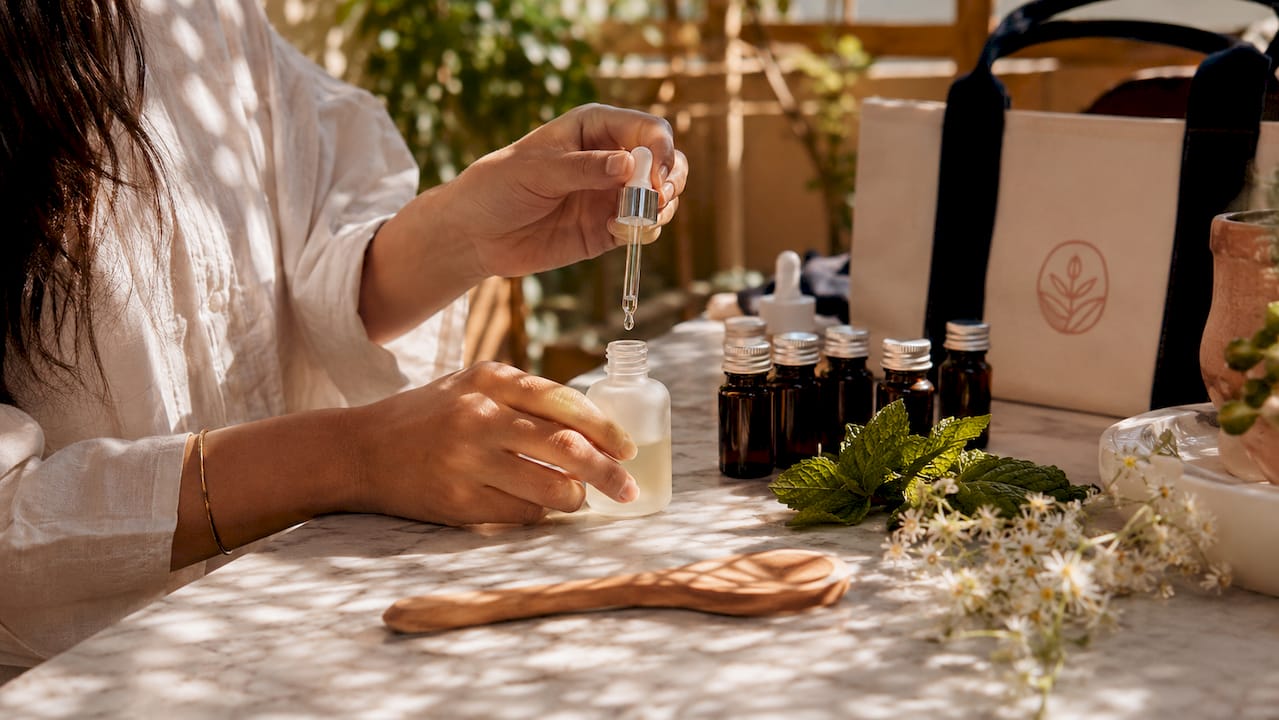
Additive effects are positive outcomes, not consolation prizes. A blend that calms the nervous system through three different mechanisms simultaneously is highly effective, even if no single pair of oils technically crosses the synergy threshold. Treating additive results as failures causes people to over-complicate their blends chasing a standard that rarely applies in home practice.
How do chemistry and aromatic notes shape your blend?
Every essential oil is a complex mixture of chemical compounds. Monoterpenes like limonene in citrus oils deliver uplifting, fast-evaporating brightness. Phenols like thymol in thyme oil provide strong antimicrobial action but can irritate skin at high concentrations. Aldehydes like citral in lemongrass bring sharp, lemony character with anti-inflammatory properties. Esters like linalyl acetate in lavender contribute calming, smooth, and skin-friendly effects. Understanding which chemical class dominates an oil tells you what it will do and how it will interact with other oils in your blend.
The aromatic note system gives you a practical framework for building balanced blends. Top, middle, and base notes correspond to volatility and aroma roles, which directly influence how your blend smells over time and how long it lasts on skin.
- Top notes (citrus oils, peppermint, eucalyptus): evaporate quickly, create the first impression, and add brightness
- Middle notes (lavender, geranium, rosemary, chamomile): form the body of the blend and last the longest on skin
- Base notes (cedarwood, sandalwood, vetiver, patchouli): evaporate slowly, add depth, and anchor the other notes so the blend does not disappear within minutes
A well-structured blend typically uses one or two top notes, one or two middle notes, and one base note. This structure creates a layered aroma that evolves pleasantly over time rather than smelling flat or one-dimensional. Compatible chemistries reinforce this structure. Pairing a calming ester-dominant oil like lavender with a grounding sesquiterpene-rich base like cedarwood produces a blend that is both emotionally coherent and aromatically balanced.
Pro Tip: Before combining oils, smell each one individually on a scent strip and let it dry for 30 seconds. Your nose will tell you whether the combination has potential before you commit a single drop to a bottle.
What tools and materials do you need to start blending?
Getting your materials right before you blend prevents the most common beginner mistakes. You do not need an expensive setup, but you do need the right setup.
Oils and quality criteria:
- Choose 100% pure essential oils with no synthetic additives or dilution in carrier oil (unless labeled as a pre-diluted blend)
- Look for oils that list the botanical Latin name, country of origin, and extraction method on the label
- Store oils in a cool, dark location away from direct sunlight
Equipment and supplies:
- Amber or cobalt glass dropper bottles (10 ml or 30 ml) to preserve oil integrity
- A glass stirring rod or pipette for mixing without contamination
- Scent strips or cotton rounds for testing before committing to a full batch
- A notebook or digital log for recording your ratios and observations
- Labels with the blend name, date, and ingredient list
Carrier oils dilute essential oils for safe topical use and affect how the blend absorbs into skin. Jojoba, sweet almond, and fractionated coconut oil are reliable, neutral-scented carriers that do not compete with your essential oil blend.
| Item | Purpose | Selection tip |
|---|---|---|
| Amber glass bottles | Protect oils from UV degradation | Use 10 ml for testing, 30 ml for final blends |
| Carrier oil | Dilute for skin application | Choose unscented to preserve blend aroma |
| Dropper or pipette | Measure drops accurately | Glass pipettes are easier to clean than plastic |
| Scent strips | Test aroma before bottling | Let strips dry 30 seconds before smelling |
| Blend journal | Record ratios and results | Date every entry for future reference |
A safe dilution ratio for most adults is 2% essential oil to carrier oil. That equals roughly 12 drops of essential oil per 30 ml of carrier. For facial application or sensitive skin, drop to 1%.
How do you blend essential oils step by step?
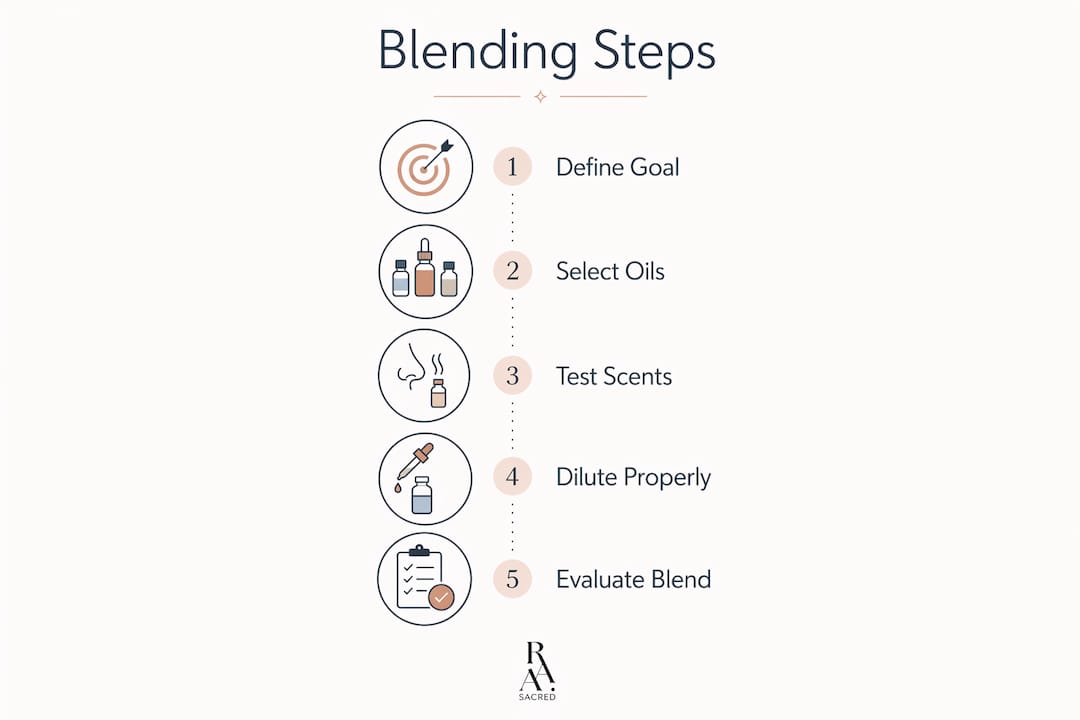
A repeatable process produces better results than intuition alone. Follow these steps each time you create a new synergy blend.
-
Define your purpose. Decide what you want the blend to do before you choose a single oil. “Relaxation before sleep” is a clear purpose. “Smells nice” is not. A clear purpose guides every decision that follows.
-
Choose your lead oil. The lead oil carries the primary therapeutic or aromatic effect you want. For a sleep blend, lavender is a natural lead. For an energizing blend, peppermint or rosemary works well. Your lead oil typically makes up 40–60% of the essential oil portion.
-
Add supporting oils. Supporting oils reinforce or complement the lead oil’s effect. For a lavender-led sleep blend, Roman chamomile adds gentle sedative depth. Bergamot adds a calming citrus brightness that rounds out the aroma. Supporting oils typically account for 30–40% of the blend.
-
Anchor with a base note. A base note like cedarwood or vetiver slows evaporation and gives the blend staying power on skin. It also adds emotional grounding. Use 10–20% of your essential oil portion for the base note.
-
Mix in small test batches first. Combine your chosen oils in a ratio of 3:2:1 (lead:support:base) on a scent strip before bottling. Smell it fresh, then again after five minutes. The aroma should feel balanced, not dominated by any single oil.
-
Record everything. Write down the exact number of drops for each oil, the carrier oil used, the dilution percentage, and your sensory notes. This record lets you reproduce a successful blend or adjust a disappointing one.
-
Let the blend rest. After bottling, let the blend sit for 24–48 hours before final evaluation. Oils need time to marry. A blend that smells sharp right after mixing often smooths out considerably after resting.
Research on a four-oil skin healing blend found that an optimized ratio of ginger, cinnamon, tea tree, and geranium produced validated high bioactivity for photoprotection and membrane support. The key was the ratio, not just the ingredient list. That principle applies to every blend you make.
Pro Tip: If your blend smells “off,” add one more drop of your base note before changing anything else. Base notes stabilize and unify. They fix more blending problems than any other adjustment.
What mistakes should you avoid when blending for synergy?
The most common mistake in synergy blending is using too many oils at once. Simple blends with 2–4 oils consistently outperform complex ones in both aroma clarity and therapeutic focus. When you add a sixth or seventh oil, you lose the ability to identify what is working and what is not.
Watch for these specific pitfalls:
- Clashing chemical families. Phenol-heavy oils like clove or thyme can overwhelm delicate ester-dominant oils like lavender. Use phenols at no more than 10–15% of the essential oil portion.
- Skipping small batch testing. Mixing a full 30 ml bottle without testing a 5-drop trial first wastes expensive oils and locks you into a blend you may not like.
- Ignoring the resting period. Evaluating a blend immediately after mixing gives you an inaccurate picture. Always smell after 24 hours.
- Neglecting dilution safety. Undiluted essential oils on skin cause sensitization over time, even with oils considered gentle. Stick to the 2% rule for body application.
- Chasing true synergy at the expense of results. Synergy is a bonus; additive combinations effectively address multiple pathways simultaneously. A blend that reliably calms, grounds, and smells beautiful is a success by any standard.
Research confirms that synergistic blends can reduce effective concentrations significantly, which means you do not need high concentrations to get strong results. Less is genuinely more in synergy blending.
Key Takeaways
Effective essential oil synergy blending requires a clear purpose, a structured note framework, compatible chemistry, and disciplined small-batch testing before you commit to a final formula.
| Point | Details |
|---|---|
| Define your purpose first | A clear therapeutic or aromatic goal guides every oil selection decision. |
| Use the top-middle-base structure | Layering notes by volatility creates balanced aroma that evolves over time. |
| Keep blends simple | Two to four oils produce clearer aroma and easier troubleshooting than complex formulas. |
| Test before bottling | Scent strip trials and a 24-hour rest period prevent wasted oils and poor results. |
| Additive effects are valid outcomes | Blends that address multiple pathways simultaneously are effective, even without true synergy. |
What I’ve learned from years of blending
Most guides treat true synergy as the goal and additive blending as a fallback. My experience runs the opposite direction. The blends I return to most often are not the ones I engineered for maximum synergistic activity. They are the ones I built with a clear emotional intention, a well-chosen lead oil, and a base note that made everything else settle.
The biggest shift in my practice came when I stopped treating chemistry as a checklist and started treating it as a conversation between ingredients. Lavender and bergamot do not just smell good together. They share overlapping calming mechanisms, and the bergamot lifts what lavender can sometimes make heavy. That relationship took me a while to notice because I was too focused on ratios.
Quality matters more than most people admit. I have used the same recipe with two different lavender oils and gotten noticeably different results. The botanical source, distillation method, and storage conditions all affect what a single oil brings to a blend. Raasacred formulates with 100% pure essential oils precisely because that consistency is the foundation everything else builds on. You cannot achieve reliable results with inconsistent ingredients.
Patience is the underrated skill in blending. Give your blend 48 hours before you judge it. Give yourself permission to make a batch that does not work. The iterative process is the practice, not a detour from it.
— Val
Ready-made synergy blends worth exploring
Creating your own blends from scratch is deeply satisfying. Sometimes, though, you want a formula that has already been tested, balanced, and refined by people who do this every day.
Raasacred’s Sacred Bloom skin layering oil is a strong starting point. It combines 100% pure essential oils with carefully selected carrier oils in a non-greasy formula designed for daily skin rituals. If you prefer portable wellness, the aromatherapy roll-ons collection offers targeted mood and wellness blends you can apply directly. For those building a layering practice at home, the fragrance layering body oils collection gives you botanical bases that work beautifully alongside your own synergy experiments.
FAQ
What is essential oil synergy blending?
Essential oil synergy blending is the intentional combining of two or more oils to produce a combined effect that is greater than or more targeted than each oil alone. It draws on aromatic note structure, chemical compatibility, and a defined therapeutic or sensory purpose.
How many oils should I use in a synergy blend?
Two to four oils produce the clearest aroma and the easiest troubleshooting. Blends with more than five oils become difficult to evaluate and adjust.
What is the difference between synergy and additive effects?
True synergy means the combined effect exceeds the sum of the parts at a specific biological target. Additive effects mean each oil contributes its own benefit independently. Both outcomes are useful; additive blends are more common and reliably effective.
What dilution ratio is safe for topical blends?
A 2% dilution, roughly 12 drops of essential oil per 30 ml of carrier oil, is the standard safe ratio for most adults applying blends to the body. Use 1% for facial application or sensitive skin.
How do I know if my blend is working?
Evaluate your blend on a scent strip after 30 seconds, then again after 24 hours of resting in a sealed bottle. A balanced blend smells coherent and evolves pleasantly. If one note dominates aggressively, adjust the ratio of that oil down by one or two drops and retest.