

Hair oil benefits strands by forming a protective barrier around the hair shaft, sealing the cuticle, and reducing protein loss that leads to breakage. This is not folklore. The mechanism is structural: oils physically reinforce the fiber from the outside in, and some oils penetrate deep into the cortex to strengthen from within. Understanding why hair oil benefits strands means separating what the science actually shows from what marketing promises. The result is healthier, stronger hair that retains length, not because growth accelerates, but because less hair breaks off.
Why hair oil benefits strands: the science of protection
Hair oil strengthens strands by reducing the protein loss that weakens each fiber over time. Every time hair is washed, combed, or exposed to heat, it loses structural proteins. Oils interrupt that cycle by coating the shaft and filling microscopic gaps in the cuticle.
The evidence is specific. MCT oil increases tensile strength of bleached hair by 29% after 21 days by reducing internal protein loss. That number matters because tensile strength is what determines whether a strand snaps or bends under stress.
Not all oils work the same way. Coconut oil penetrates the hair cortex and reduces protein loss, while argan oil primarily coats the surface without deep penetration. The difference comes down to molecular weight. Coconut oil’s lauric acid is small enough to travel through the cuticle and into the cortex. Argan oil, with its larger molecules, stays on the surface and smooths the outer layer instead.

Both effects are useful. Surface coating reduces friction and environmental damage. Deep penetration reinforces the keratin structure that gives each strand its integrity. Regular oil application improves the resilience and longevity of existing hair at a cellular level.
Key benefits of hair oil for strand strength:
- Protein loss reduction: Oils fill the cell membrane complex, slowing the leaching of keratin during washing.
- Cuticle sealing: A smooth, sealed cuticle resists friction from styling tools and fabric.
- Tensile strength: Oils that penetrate the cortex physically reinforce the fiber’s load-bearing structure.
- Environmental shielding: The oil layer buffers strands against UV exposure, humidity, and pollution.
Pro Tip: Apply oil to dry hair before washing, not after. Pre-wash oiling gives the oil time to penetrate and fill the cuticle before water swells the fiber open.
How does hair oil improve moisture retention and frizz?
Hair oil controls frizz by sealing the cuticle so moisture cannot escape or enter erratically. Frizz happens when the cuticle lifts and the strand absorbs humidity unevenly. Oil prevents that by creating a physical seal over the surface.
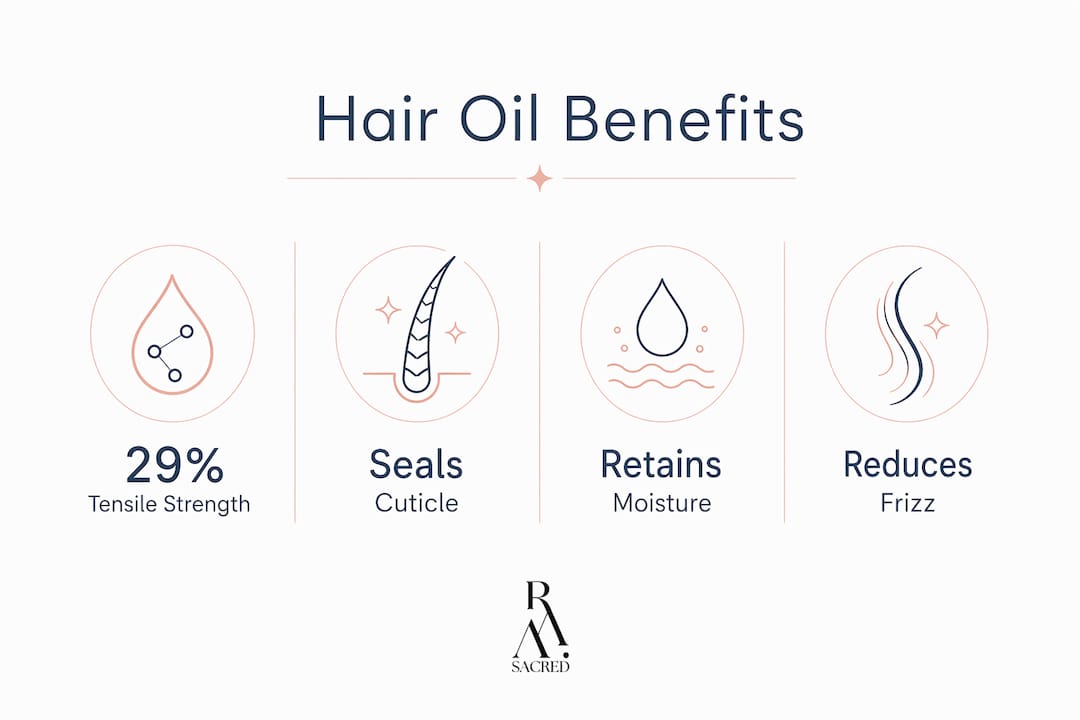
Hair oils form a protective barrier that seals the cuticle, reduces friction, traps moisture, and enhances shine. The shine effect is a direct result of cuticle alignment. When the cuticle lies flat, light reflects off the surface evenly. When it is lifted or damaged, light scatters and the hair looks dull.
The moisture retention benefit works in two directions. First, oil slows the evaporation of water already inside the strand. Second, it reduces the amount of external humidity that enters. Both effects make hair more predictable and easier to manage throughout the day.
Here is how to apply oil for maximum moisture retention:
- Start with damp hair. Apply oil to hair that is slightly damp after washing. Water is already inside the strand, and oil seals it there.
- Use a small amount. A few drops distributed from mid-length to ends is enough. More oil does not mean more moisture.
- Focus on the ends. The ends are the oldest, most porous part of the strand and lose moisture fastest.
- Avoid the roots. Applying oil to the scalp when targeting moisture retention adds unnecessary weight and can clog follicles.
- Layer over a leave-in conditioner. Oil works best as a sealant over a water-based moisturizer, not as a replacement for one.
Different hair types need different oils for moisture work. Fine hair benefits from lightweight options like grapeseed oil, which absorbs quickly without weighing strands down. Coarse or thick hair handles heavier oils like avocado oil, which provide a richer seal and longer-lasting moisture lock.
How to choose the right hair oil for your hair type
The right oil depends on your hair’s porosity, texture, and what you need it to do. Porosity determines how easily your hair absorbs and holds moisture. High-porosity hair absorbs quickly but loses moisture just as fast. Low-porosity hair resists absorption and needs lighter oils that do not sit on the surface.
| Hair type | Best oil choice | Primary benefit |
|---|---|---|
| Fine or low-porosity | Grapeseed, argan | Lightweight surface smoothing |
| Medium or normal | Coconut, jojoba | Penetration and moisture balance |
| Coarse or high-porosity | Avocado, castor | Deep sealing and protein support |
| Color-treated or bleached | MCT, coconut | Protein loss reduction and tensile repair |
Heavier oils suit coarse or thick hair, while lighter oils work better for fine hair. This is not just about weight. Heavier oils have larger molecules that sit on the surface longer, which is exactly what high-porosity hair needs to prevent moisture from escaping. Fine hair gets weighed down by those same molecules.
Frequency matters as much as oil type. Oily scalps need less frequent application than dry scalps. There is no universal frequency that works for everyone. The ideal schedule depends on your scalp type, hair texture, and how your hair responds over time.
For a more personalized approach to selecting and blending oils, Raasacred’s guide on customizing oil blends walks through how to match botanical ingredients to specific hair needs.
Pro Tip: Test a new oil on a small section of hair for one week before committing to a full routine. Your hair’s response tells you more than any ingredient list.
Common misconceptions about hair oil use
The most persistent myth about hair oil is that it makes hair grow faster. Hair oil does not increase follicle activity or the number of hairs on your head. Hair growth averages 1 cm per month regardless of what you apply to the shaft. What oil does is reduce breakage, so the hair you already have survives long enough to reach visible lengths. The perceived growth is actually retention.
A second common mistake is over-oiling. Daily oiling can cause scalp irritation, acne, and yeast proliferation that leads to dandruff. Excess oil on the scalp feeds Malassezia, a naturally occurring yeast that causes flaking when it overgrows. The irony is that over-oiling often leads to more frequent washing, which causes the very damage the oil was meant to prevent.
Best practices for hair oil use:
- Pre-wash application works better than post-wash for protection. Pre-wash oiling reduces water uptake during shampooing, preventing fiber swelling and structural damage.
- Less is more. Two to four drops is a full application for most hair lengths.
- Scalp and strand oiling are different practices. Scalp oiling addresses the skin and follicle environment. Strand oiling addresses the fiber itself. They do not always need to happen together.
- Consistency beats intensity. A light application twice a week outperforms a heavy application once a month.
- Oil is not a conditioner replacement. Oil seals. Conditioner replenishes. Both serve different functions and work best together.
The goal of a hair oil ritual is the longevity and health of existing hair, not boosting follicle production. Keeping that goal clear prevents the over-application that undermines results.
Key Takeaways
Hair oil benefits strands by reducing protein loss, sealing the cuticle, and improving moisture retention, not by accelerating growth.
| Point | Details |
|---|---|
| Oil strengthens by reducing protein loss | MCT oil increased tensile strength by 29% in 21 days by limiting internal protein leaching. |
| Penetration depth varies by oil | Coconut oil reaches the cortex; argan oil smooths the surface. Both effects are useful. |
| Frizz control comes from cuticle sealing | Oil prevents erratic moisture exchange, keeping the cuticle flat and light-reflective. |
| Match oil weight to hair type | Fine hair needs lightweight oils; coarse hair benefits from heavier, richer options. |
| Over-oiling causes real harm | Daily oiling can trigger dandruff and scalp irritation; two to three times per week is a safer baseline. |
What I’ve learned from years of watching people oil their hair wrong
Most people treat hair oil like a rescue product. They reach for it when hair looks bad, apply too much, and expect results overnight. That approach misses the point entirely.
The real value of hair oil is preventive. You apply it before damage happens, not after. Pre-wash oiling, consistent twice-weekly application, and choosing the right oil for your actual hair type are the habits that produce visible results over months. None of them are dramatic. All of them work.
What I find most overlooked is the ritual dimension. Applying oil with intention, taking two minutes to work it through your strands, gives you direct feedback about your hair’s condition. You notice changes in texture, elasticity, and moisture before they become problems. That awareness is worth as much as the oil itself.
The brands and products that resonate with me are the ones that treat hair care as a daily practice rather than a fix. Raasacred’s approach to botanical blends reflects that philosophy. The beauty rituals guide they publish is a good example of how to think about oil use as part of a longer-term routine rather than a one-time treatment.
Quality matters more than quantity. Two drops of a well-formulated botanical oil does more than a tablespoon of a generic one. Spend your attention on understanding what your hair actually needs, and let that guide what you reach for.
— Val
Raasacred’s Sacred Bloom: botanical care for your strands
Raasacred formulates its botanical hair oils with the same principle this article is built on: protect and nourish the strand rather than chase quick fixes. The Sacred Bloom oil combines 100% pure essential oils with carefully selected carrier oils to deliver a non-greasy, deeply nourishing experience. It is designed for people who want their hair care to feel intentional, not complicated. If you are ready to build a consistent oil ritual with a formula that respects your hair’s structure, the Sacred Bloom collection is a strong place to start. Browse the full botanical hair oil range at Raasacred to find the right fit for your hair type and routine.
FAQ
Does hair oil actually make hair grow faster?
Hair oil does not increase follicle activity or hair growth rate. It reduces breakage, which allows existing hair to retain length over time.
How often should I apply hair oil?
Frequency depends on your scalp type and hair texture. Two to three times per week is a reasonable starting point for most people, with adjustments based on how your scalp responds.
Can I use hair oil every day?
Daily oiling can cause scalp irritation, acne, and dandruff by feeding yeast on the scalp. Most people get better results with less frequent, more deliberate application.
What is the best hair oil for fine hair?
Lightweight oils like grapeseed or argan oil work best for fine hair. They smooth the cuticle without weighing strands down or leaving a greasy residue.
When is the best time to apply hair oil?
Pre-wash application is the most protective method. Applying oil before shampooing reduces water uptake during washing and prevents the fiber swelling that causes structural damage.