

A multi-use beauty oil is a lightweight botanical oil blend formulated to work across your face, body, hair, and nails as a single product: instead of reaching for four different bottles, you use one. The core function is sealing: applied correctly, these oils lock moisture into your skin rather than adding water themselves, leaving a non-greasy glow that heavier creams often can’t match. Raasacred builds its formulas around this principle, pairing 100% pure essential oils with fast-absorbing carriers like jojoba and vitamin E to make the ritual feel effortless rather than complicated.
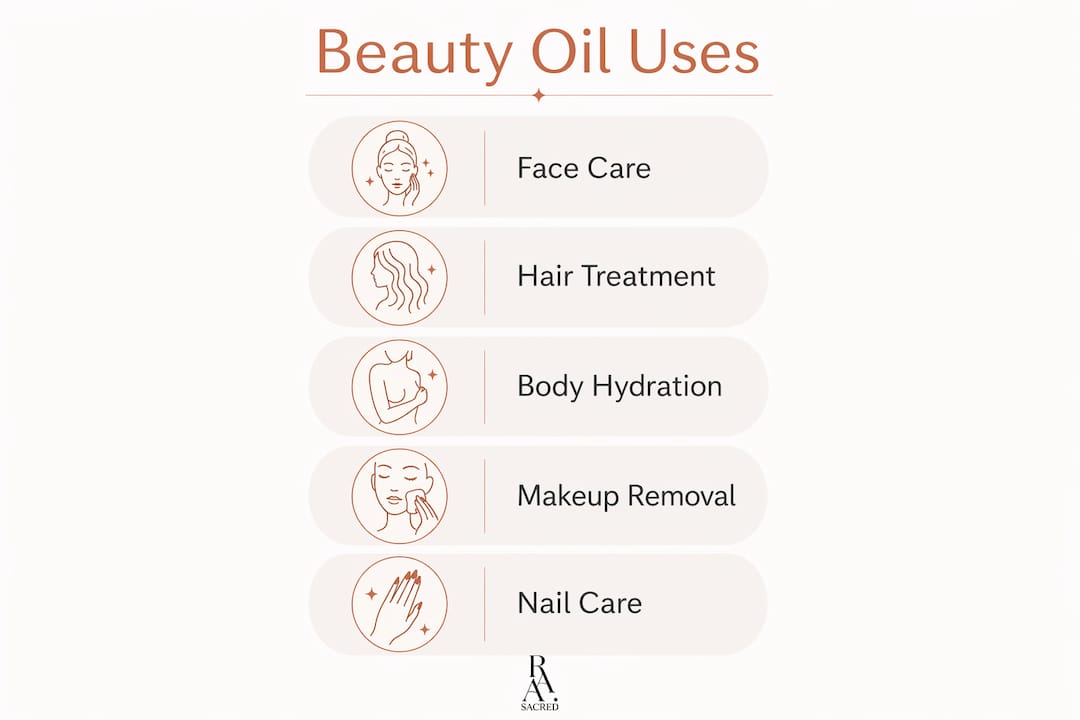
Top four ways people use a multi-use beauty oil:
- Face: a small amount pressed into damp skin as a leave-on serum or mixed into moisturizer
- Hair ends: a small amount warmed between palms, smoothed from mid-lengths down
- Body: a small amount massaged into damp skin right after a shower to seal hydration
- Makeup removal: massaged onto dry skin, then emulsified with warm water before a light cleanser
Table of Contents
- How can you use a multi-purpose facial oil every day?
- How do multi-use beauty oils actually work on your skin?
- Step-by-step: how to use beauty oil for face, hair, body, and makeup removal
- Which carrier oils and ingredients should you look for?
- Who should patch-test, and when should you avoid beauty oils?
- Key Takeaways
- The case for simplifying your routine around one good oil
- Raasacred Sacred Bloom: one bottle for your whole ritual
- Useful sources and further reading
How can you use a multi-purpose facial oil every day?
The short answer: more ways than most people realize. A single bottle can replace several products in your routine without adding time.
- Face serum or finish: Apply a small amount after toning on damp skin. For daytime, mix a little into your moisturizer to sheer it out and add a subtle glow. For Gua Sha or facial massage, some extra oil gives the tool enough slip to glide without dragging.
- Body moisturizer: Apply immediately after a shower while skin is still damp. Focus on elbows, knees, and shins first, then smooth outward. The body oil skincare benefits are most visible when you apply before you towel off completely.
- Hair ends treatment: Warm a small amount between your palms and press it into mid-lengths and ends only. Avoid the roots if your hair is fine. For a scalp massage, use a small amount and work in small circular motions once or twice a week.
-
Makeup removal: Massage 1–2 pumps onto a dry face, let it dissolve foundation and mascara for 30 seconds, then emulsify with warm water. Follow with a to lift residue. Double-cleanse if you wore heavy or waterproof makeup.
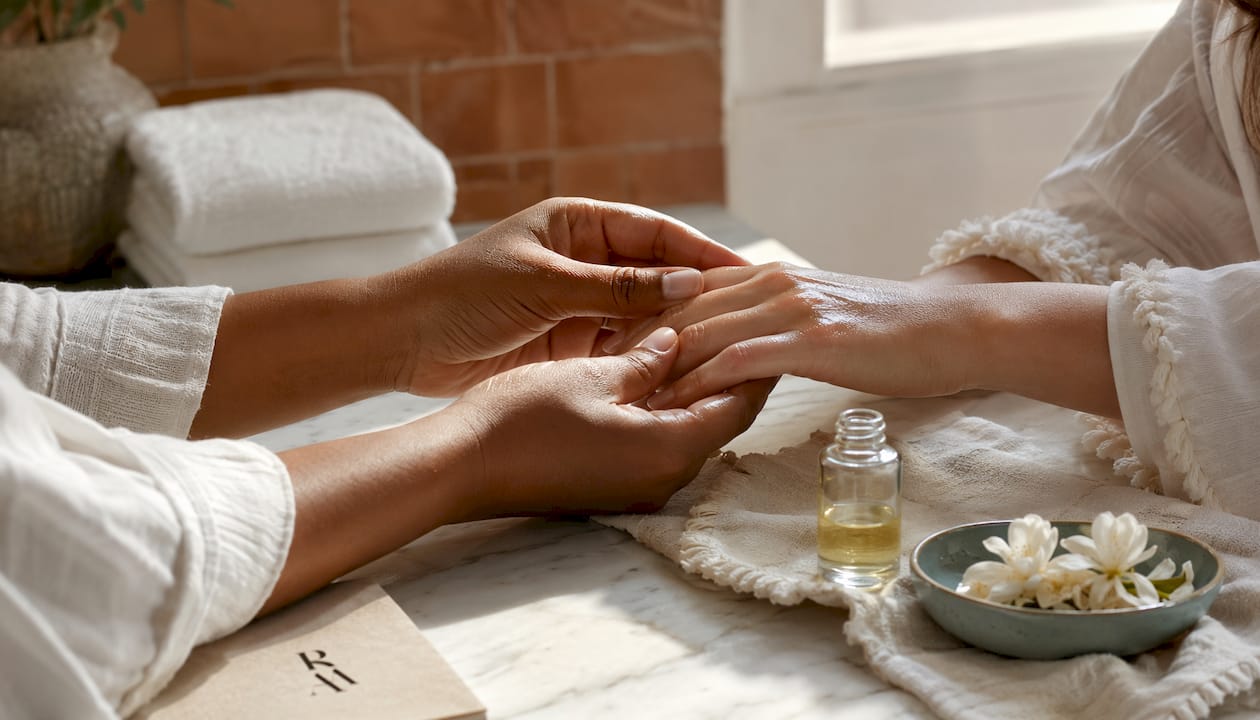
- Cuticles and nails: Dot a small amount around each nail bed at night and massage in. Consistent nightly use softens and repairs dry cuticles within a week or two.
- Shimmer finish: Some formulas include a cosmetic shimmer component. Use sparingly on collarbones or shoulders, not on the face, and blend well so it reads as a glow rather than glitter.
Pro Tip: For travel or minimal-makeup days, one oil can replace your moisturizer, hair serum, and hand cream. Pack one bottle instead of three.
How do multi-use beauty oils actually work on your skin?
The key distinction most people miss: oils are sealants, not moisturizers. They don’t add water to your skin. They trap the water that’s already there.
Your skin loses moisture constantly through a process called transepidermal water loss. Applying an oil after a shower or after a water-based serum creates a barrier that slows that loss. The result is skin that stays hydrated longer, not just skin that feels oily for an hour.
- Dry oil behavior: Certain carriers, particularly jojoba and squalane, are structurally similar to your skin’s natural sebum. They absorb quickly and leave a satin finish rather than a greasy film. This is why “dry oil” formulas are popular for daytime use.
- Penetration depth: Lighter oils absorb into the upper layers of the skin; heavier oils like castor sit on top. Most multi-use formulas use a blend to balance absorption speed with barrier protection.
- Antioxidant role: Vitamin E (tocopherol) is a common addition because it helps neutralize free radicals and supports barrier repair. Essential oils in the formula add targeted benefits, from calming lavender to brightening rosehip.
- Timing matters most: Experts consistently point to damp skin as the optimal application window. The oil seals the water droplets sitting on your skin’s surface, multiplying the hydration effect compared to applying on dry skin.
Pro Tip: Use the oil as an overnight treatment by applying 3–4 drops to slightly damp skin before bed. For daytime, 1–2 drops mixed into moisturizer keeps the finish light enough for makeup.
Step-by-step: how to use beauty oil for face, hair, body, and makeup removal
Clear amounts and layering order make the difference between a routine that works and one that just feels greasy.
Face routine:
- Cleanse with your usual cleanser and rinse without fully drying your face.
- Apply toner or essence if you use one, and let it absorb for 20 seconds.
- Dispense 2–3 drops of oil into your palms, press your hands together once, and press the oil into your skin rather than rubbing.
- Follow with SPF for daytime. At night, the oil is your last step.
- For a daytime alternative, mix 1 drop into your moisturizer before applying. This sheers out the oil and prevents any heavy finish. The full facial oil application guide covers layering in more detail.
Makeup removal:
- Start with a dry face and dry hands.
- Dispense 1–2 pumps and massage gently over your entire face for 30–60 seconds, including eye makeup.
- Add a small splash of warm water and continue massaging. The oil will turn milky as it emulsifies.
- Rinse thoroughly, then follow with a mild water-based cleanser.
Hair routine:
- Warm 1–2 drops between your palms until the oil feels slightly heated.
- Smooth from mid-lengths to ends, avoiding the scalp for fine hair.
- For a scalp treatment, use 3–4 drops and massage in circular motions for 2–3 minutes, once or twice a week.
Body routine:
- After showering, shake the bottle and dispense 3–6 drops per limb.
- Smooth in long strokes on damp skin before toweling off.
- Use more on very dry areas like heels and elbows. A dry skin body oil routine can help you build this into a daily habit.
Nails and cuticles: Dot a small amount around each nail bed at night and massage in for 30 seconds.
Pro Tip: If you notice buildup or a heavy feeling, you’re using too much. Cut the amount in half. Oily skin types do well with 1–2 drops on the face; dry skin types can go up to 4.
Which carrier oils and ingredients should you look for?
The carrier oil base determines how an oil feels, absorbs, and performs for your skin type. Here’s what each common option actually does:
- Jojoba: Technically a liquid wax, not an oil. It mimics skin sebum closely, absorbs fast, and is one of the lower-risk options for acne-prone skin.
- Squalane: Derived from sugarcane or olives. Extremely lightweight, non-comedogenic, and excellent for sensitive or combination skin. Pairs well with almost every other ingredient.
- Argan: Rich in oleic acid and antioxidants. Absorbs well and adds a subtle shine to hair. A solid all-rounder for normal to dry skin.
- Rosehip: Contains naturally occurring retinoids and vitamin C precursors, which makes it particularly useful for aging skin, hyperpigmentation, and uneven texture. For more on this, the botanical oils for aging skin guide goes deeper.
- Camellia: Light texture with a high oleic acid content. Absorbs quickly and works well for fine hair and skin that tends toward sensitivity.
- Vitamin E (tocopherol): A barrier-repair antioxidant found in most quality formulas. Also acts as a natural preservative.
- Omegas (3, 6, 9): Support skin elasticity and help maintain the lipid barrier over time.
For acne-prone skin, prioritize jojoba and squalane bases. Avoid coconut oil on the face; it sits high on the comedogenic scale. Always check carrier oil compatibility before adding a new formula to your routine.
Non-comedogenic note: No oil is guaranteed to be 100% non-comedogenic for every person. Comedogenicity ratings are based on rabbit-ear studies and don’t always translate to human skin. Patch-testing is the only reliable way to know how your skin responds.
Who should patch-test, and when should you avoid beauty oils?
Most people can use botanical oils without issue, but a few situations call for extra caution.
- Patch-test checklist: Apply a small amount to the inside of your wrist or behind your ear. Wait 24–48 hours. Watch for redness, itching, swelling, or breakouts before applying to your face.
- Nut-based oils: Sweet almond, macadamia, and similar oils carry a risk for people with tree-nut allergies. Read ingredient lists carefully and choose nut-free alternatives like squalane or sunflower seed oil.
- Essential oil concentrations: High concentrations of certain essential oils, particularly bergamot, can be phototoxic, meaning they increase UV sensitivity when applied before sun exposure. Look for formulas with low essential oil percentages, or choose fragrance-free options if you have sensitive skin.
- Pregnancy: Some essential oils are not recommended during pregnancy. Consult your healthcare provider before adding a new essential-oil formula to your routine.
- Oily and acne-prone skin: Use sparingly on the face. Stick to 1–2 drops maximum and choose non-comedogenic bases. A quick skincare routine for oily skin can help you figure out where an oil fits without tipping into congestion.
- Aging and dry skin: These skin types tend to benefit most. Heavier application (3–4 drops) and overnight use are generally well-tolerated.
This article is general information, not medical or dermatological advice. Confirm ingredient safety with a qualified professional if you have specific skin conditions or allergies.
Key Takeaways
A multi-use beauty oil is a botanical sealant that locks hydration into face, hair, and body when applied to damp skin, replacing multiple single-use products with one well-formulated bottle.
| Point | Details |
|---|---|
| Definition | A lightweight oil blend that works on face, body, hair, and nails as one product. |
| Top use cases | Face on damp skin, hair ends treatment, and makeup removal cover most daily needs. |
| Best timing | Apply on damp skin post-shower to seal hydration; this is when oils perform best. |
| Ingredient picks | Choose jojoba or squalane bases; look for vitamin E; patch-test before full use. |
| Raasacred Sacred Bloom | Raasacred’s Sacred Bloom combines essential oils with fast-absorbing carriers for a non-greasy, multi-use skin layering ritual. |
The case for simplifying your routine around one good oil
The beauty industry has a habit of selling complexity. Separate serums for brightening, firming, and hydration, each with its own layering rule and price tag. A well-made multi-use oil cuts through that.
What most people underestimate is how much of skincare’s effectiveness comes down to consistency and timing rather than the number of products used. One oil, applied to damp skin every day after a shower, will outperform a five-step routine done inconsistently. The ritual matters as much as the formula.
My honest take: start with one use case and build from there. If you’re new to oils, try the body application first. It’s the lowest-stakes entry point, the results are visible within days, and it builds the habit of reaching for the bottle. Once that’s automatic, add the face application. Most people find they need far fewer products than they thought once they understand what an oil actually does.
For travel, a single 30ml bottle of a quality multi-use oil can replace your body lotion, hair serum, and cuticle treatment. That’s a meaningful simplification for a carry-on.
Raasacred Sacred Bloom: one bottle for your whole ritual
If you’ve read this far, you already know what to look for in a multi-use oil: fast-absorbing carriers, vitamin E, a non-greasy finish, and a formula you can use from face to hair to body without switching products.
Sacred Bloom is Raasacred’s answer to exactly that. It’s a skin layering oil built around 100% pure essential oils and carefully selected botanical carriers, designed for the kind of daily ritual that takes two minutes and actually shows results. Non-greasy, botanically grounded, and formulated to work on damp skin where oils perform best. Browse the full botanical body oil collection to find the right fit for your routine, or go straight to Sacred Bloom and start with one bottle.
Useful sources and further reading
- Body Oil Skincare Benefits for Hydrated, Nourished Skin — Raasacred’s guide to how botanical oils restore barrier function and hydration
- Dry Skin Body Oil Routine: Get Hydrated Skin Daily — step-by-step daily routine for dry skin types
- Facial Oil Application Guide for Glowing Skin — amounts, layering order, and technique for face application
- Best Carrier Oils for Essential Oil Blending in 2026 — ingredient-level guide to selecting carrier oils by skin type
- Botanical Oils for Aging Skin: What Really Works — evidence-based recommendations for mature skin
- Sacred Bloom Skin Layering Oil — Raasacred’s primary multi-use botanical oil product
- Five-Minute Skincare Routine: Simple Steps That Work — practical guide for building a streamlined oil-based routine