

Natural oils penetrate skin because their lipophilic molecular structure matches the lipid composition of the stratum corneum, the skin’s outermost barrier layer. This compatibility allows oil molecules to integrate directly into the skin’s lipid matrix rather than sitting on the surface. The process is called transcutaneous absorption, and it explains why a well-chosen botanical oil feeds skin at a cellular level while a poorly matched one just coats it. Understanding the science behind skin absorption of natural oils helps you choose products that actually work.
Why natural oils penetrate skin: the lipid barrier explained
The stratum corneum is the primary gatekeeper of everything that enters or exits your skin. It consists of flattened dead skin cells embedded in a lipid matrix made of ceramides, cholesterol, and fatty acids in a 3:1:1 molar ratio. That specific ratio is not arbitrary. It creates a tightly organized lamellar structure that blocks most foreign molecules while allowing water and lipid-compatible substances to pass through.
Natural oils earn entry because they are lipophilic. That means they are chemically attracted to fats, and the stratum corneum is essentially a fat-based wall. When an oil’s fatty acid profile closely mirrors the skin’s own lipids, the barrier treats it as a native substance rather than a foreign intruder. This is the principle behind biomimetic formulation, where oils are selected to mimic native stratum corneum lipids and bypass the skin’s rejection mechanisms.

Molecular size also matters. The skin’s barrier blocks most molecules above 500 Daltons through passive diffusion. Most natural carrier oils contain fatty acid chains that fall within or near this threshold, which is why they absorb while heavier synthetic polymers do not. The barrier evolved to retain moisture and block pathogens, not to welcome every substance applied to it. Natural oils work with that biology rather than against it.
Pro Tip: Apply your body oil immediately after a shower, while skin is still slightly damp. Hydrated skin has a more permeable stratum corneum, which improves oil absorption noticeably.
How fatty acid profiles shape absorption and skin compatibility
The fatty acid composition of an oil determines how fast it absorbs, how deeply it penetrates, and which skin types benefit most from it. This is the single most useful framework for choosing a natural oil, and most skincare labels ignore it entirely.
Oleic acid vs. linoleic acid
Oleic acid is a monounsaturated fatty acid found in high concentrations in oils like argan, avocado, and marula. It penetrates deeply into the skin and delivers rich nourishment, making it ideal for dry or mature skin. The trade-off is that oleic acid can be comedogenic at high levels, meaning it may clog pores in acne-prone or oily skin types.
Linoleic acid is a polyunsaturated fatty acid found abundantly in rosehip, grapeseed, and hemp seed oils. It absorbs faster, sits lighter on the skin, and supports the skin barrier without blocking pores. Linoleic acid deficiency is directly linked to sebum imbalance and is common in acne-prone skin. Replenishing it through topical oils helps restore barrier function and reduce breakouts.
Fatty acid profiles by skin type
- Dry or mature skin: Oils high in oleic acid (argan, avocado, marula) deliver deep nourishment and slow-release moisture.
- Oily or acne-prone skin: Oils high in linoleic acid (rosehip, grapeseed, hemp seed) absorb fast and balance sebum without clogging pores.
- Sensitive skin: Oils with balanced oleic and linoleic ratios, such as jojoba and sea buckthorn, support barrier repair without overwhelming the skin.
- Combination skin: Lighter linoleic-dominant oils work well on the T-zone, while richer oleic-dominant oils can be applied to drier areas.
Palmitic acid and lauric acid are saturated fatty acids found in coconut oil and shea butter. They provide occlusive protection and slow moisture loss, but their larger molecular structure means they sit closer to the skin surface rather than penetrating deeply. They are excellent for barrier support but less effective for deep nourishment.
Pro Tip: Check the first three ingredients in any botanical oil product. The fatty acid profile of those top ingredients determines how the oil will actually behave on your skin.
What is the 500-Dalton rule and why does it matter for oils?
The 500-Dalton rule is the most important principle in topical skincare that most people have never heard of. It states that molecules above 500 Daltons in molecular weight cannot passively diffuse through the stratum corneum. This threshold explains why many skincare actives fail to deliver results. They are simply too large to enter the skin.
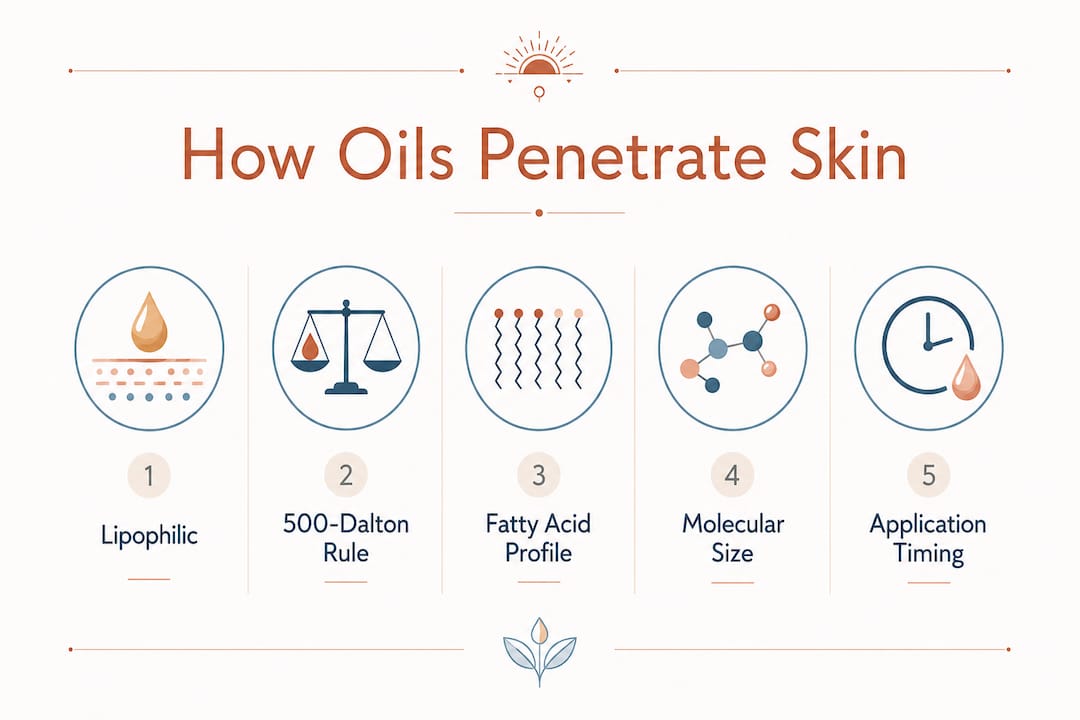
Natural oils navigate this rule through two mechanisms. First, their fatty acid chains are often small enough to fall within the passive diffusion window. Second, their lipophilicity gives them chemical affinity for the skin’s lipid matrix, which assists entry even when molecular size is borderline. Absorption depends on molecule size, formula design, skin condition, and hydration level working together. No single factor determines penetration alone.
Nanotechnology has extended what is possible beyond passive diffusion. Lipid-based nanoparticles engineered to mimic the stratum corneum’s lipid composition can carry active ingredients into deeper skin layers. The effective penetration window for these particles is 20–200 nm in size. Particles above 200 nm accumulate on the skin surface without penetrating. Particles below 20 nm are cleared too quickly by skin circulation to deliver a meaningful effect.
The practical takeaway for natural oil users is this: you do not need nanotechnology to benefit from deep oil penetration. Choosing oils with the right fatty acid profile and applying them correctly achieves meaningful transcutaneous absorption through entirely natural chemistry.
How to choose and apply natural oils for maximum absorption
Viscosity is the first practical signal of how an oil will absorb. Oils that are liquid at room temperature generally absorb faster than semi-solid fats. Linoleic-rich oils have lower viscosity and absorb more rapidly. Oleic-rich oils feel richer and absorb more slowly. Neither is better. They serve different skin needs.
The most common misconception about natural oils is that a heavy texture means poor absorption. Texture reflects viscosity, not penetration depth. A thick oil like avocado can penetrate deeply into the dermis while a light silicone-based product sits entirely on the surface. The science of oil penetration comes down to molecular chemistry, not how the product feels in your hand.
- Match the oil to your skin’s current condition. Barrier-damaged or very dry skin needs oleic-dominant oils for deep repair. Oily or congested skin needs linoleic-dominant oils for balance.
- Warm the oil before applying. Rubbing a few drops between your palms for 10 seconds raises the oil’s temperature and lowers its viscosity, improving how quickly it absorbs.
- Layer strategically. Apply lighter, faster-absorbing oils first. Follow with richer, slower-absorbing oils to seal in the first layer. This mirrors the skin layering approach used in professional botanical skincare.
- Apply to damp skin. Hydrated skin is more permeable. Applying oil to damp skin after a shower or misting the face first increases absorption significantly.
- Use less than you think you need. Two to four drops of a well-formulated oil covers the entire face. Excess oil sits on the surface and does not penetrate. It just feels greasy.
Pro Tip: For body application, try personalizing your oil blend by mixing a fast-absorbing linoleic oil with a slower oleic oil. You get immediate comfort and long-term nourishment in one step.
Key Takeaways
Natural oils penetrate skin because their lipophilic fatty acid profiles allow them to integrate directly into the stratum corneum’s lipid matrix, bypassing the barrier that blocks most synthetic molecules.
| Point | Details |
|---|---|
| Lipid barrier compatibility | Natural oils enter skin by matching the ceramide, cholesterol, and fatty acid structure of the stratum corneum. |
| Fatty acid profiles drive absorption | Linoleic-rich oils absorb fast and suit oily skin; oleic-rich oils penetrate deeply and suit dry or mature skin. |
| The 500-Dalton rule | Molecules above 500 Daltons cannot passively diffuse through skin; natural oils often fall within this threshold. |
| Viscosity is not penetration | A thick texture does not mean poor absorption; molecular chemistry determines how deep an oil actually goes. |
| Application method matters | Warming oil, applying to damp skin, and layering lighter oils first all improve how well natural oils absorb. |
The part most skincare advice gets wrong about oil absorption
The conversation around natural oil absorption tends to collapse into two camps: people who believe oils are too heavy to absorb, and people who believe every oil penetrates deeply and feeds skin at a cellular level. Both views are incomplete.
What I find most overlooked is the balance between fast and slow-penetrating oils. Chasing instant absorption is a mistake. Proper formulation balances oils for immediate skin comfort with slower-penetrating lipids for long-term barrier health. A routine built entirely on fast-absorbing linoleic oils may feel light and non-greasy, but it can leave the barrier under-protected over time.
The oils that genuinely restore skin are often the ones that take a moment to absorb. Biomimetic oils, those formulated to mirror the stratum corneum’s own lipid ratios, do not just sit on the surface or rush through it. They integrate. That integration is what supports real barrier repair rather than temporary surface hydration.
The choice of oil must match the skin’s current needs, whether that is restoring barrier function or balancing sebum production. A single “best oil” does not exist. What exists is the right oil for your skin’s condition right now. That requires paying attention to how your skin responds, not just following a trending ingredient.
— Val
Raasacred’s botanical oils, formulated for how skin actually absorbs
Raasacred builds its botanical oil formulas around the same science covered in this article. Each blend is developed with a balanced fatty acid profile, combining fast-absorbing and slow-penetrating oils to deliver both immediate comfort and lasting nourishment.
The Sacred Bloom skin layering oil is designed specifically for layered application, with a formula that absorbs without a greasy finish and works across skin types. It reflects Raasacred’s commitment to non-greasy, botanically grounded care that respects the skin’s barrier rather than overwhelming it. For a broader look at what Raasacred offers, the full botanical body oil collection covers a range of skin needs and conditions.
FAQ
Why do natural oils absorb into skin better than synthetic ones?
Natural oils are lipophilic and share molecular similarities with the skin’s own lipid barrier, allowing them to integrate rather than sit on the surface. Synthetic ingredients often exceed the 500-Dalton threshold or lack the lipid compatibility needed for passive diffusion.
Which natural oil absorbs fastest into skin?
Oils high in linoleic acid, such as rosehip, grapeseed, and hemp seed, absorb fastest because they have lower viscosity and a molecular profile that moves quickly through the stratum corneum’s lipid matrix.
Can natural oils penetrate all skin types effectively?
Oil penetration depends on matching the oil’s fatty acid profile to the skin’s current condition. Linoleic-dominant oils suit oily and acne-prone skin, while oleic-dominant oils suit dry or mature skin. The wrong match reduces both absorption and benefit.
Does applying oil to damp skin really improve absorption?
Yes. Hydrated skin has a more permeable stratum corneum, which lowers resistance to oil molecules passing through. Applying oil immediately after a shower or after misting the skin measurably improves how well it absorbs.
What is the 500-Dalton rule in skincare?
The 500-Dalton rule states that molecules above 500 Daltons in molecular weight cannot passively diffuse through the stratum corneum. Natural oils often fall within this limit, which is one reason they penetrate skin more effectively than many synthetic skincare actives.