

Topical antioxidants do one thing above all else: they neutralize free radicals before those unstable molecules can damage your skin cells, collagen, and DNA. Pair them with SPF every morning and a plant-forward diet, and you have the most evidence-backed daily skin protection available without a prescription. Here’s the short version of what that looks like in practice:
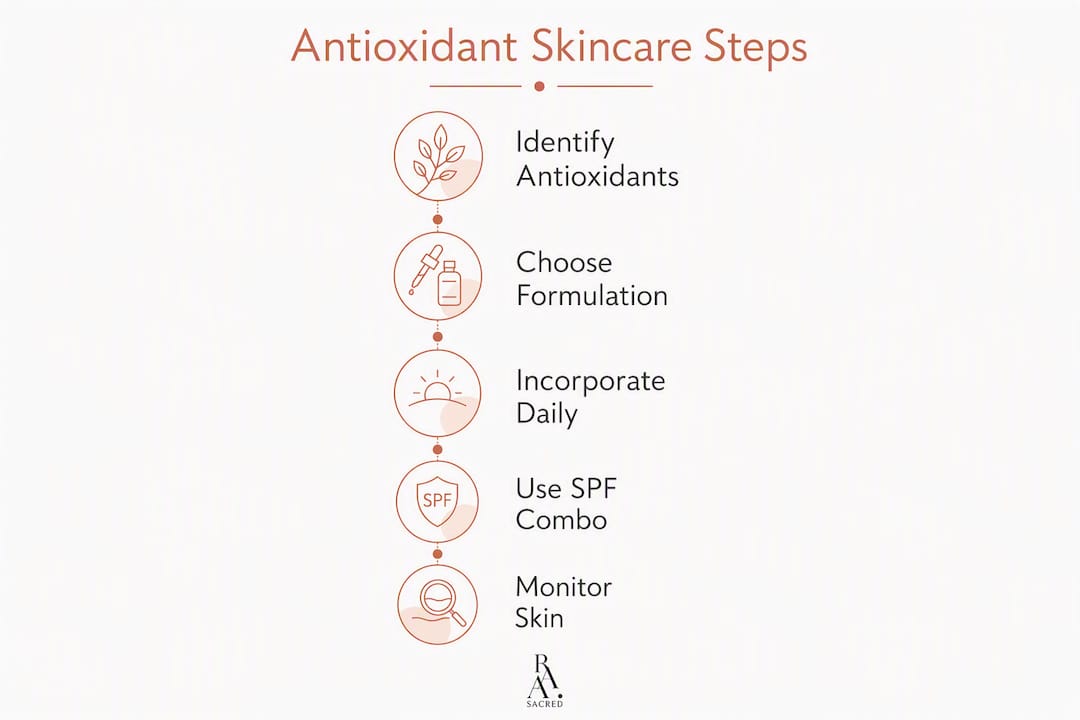
- Step 1: Apply an antioxidant serum or lightweight botanical oil after cleansing each morning.
- Step 2: Follow immediately with broad-spectrum SPF. Antioxidants complement sunscreen — they do not replace it.
- Step 3: Eat a colorful, plant-rich diet daily. Dietary phytonutrients work synergistically with what you apply topically.
Raasacred’s Sacred Bloom skin-layering oil is one example of a botanical multi-antioxidant formula built around this exact logic.
Table of Contents
- How antioxidants protect your skin — the simple science
- Top antioxidant ingredients you’ll actually find on labels
- Why formulation and packaging matter more than the ingredient name
- How to build antioxidants into your daily routine
- What results to expect, and when
- Safety, irritation, and when to stop
- Diet, lifestyle, and why topical-only isn’t enough
- How to choose a botanical antioxidant product
- How Raasacred’s Sacred Bloom reflects these principles
- Key Takeaways
- The part most antioxidant guides skip
- Raasacred’s plant-based antioxidant oils for your daily ritual
How antioxidants protect your skin — the simple science
Antioxidants neutralize reactive oxygen species (ROS), reduce inflammation, and support cellular repair — the three mechanisms most responsible for slowing visible photoaging. ROS are generated constantly by UV exposure, pollution, and normal cellular metabolism. When they accumulate faster than your skin can handle, oxidative stress sets in, breaking down collagen and triggering inflammation.

Your skin already carries its own defense network. Enzymatic systems like superoxide dismutase (SOD) and catalase work alongside small molecules such as Vitamin C, Vitamin E, and glutathione, distributed unevenly across epidermal layers. Topical antioxidants replenish those reservoirs when UV and environmental exposure deplete them faster than the body can restore them.
Sunscreen blocks the UV photons that trigger ROS in the first place. Antioxidants mop up the ROS that still get through. Neither works as well without the other.
Pro Tip: Think in networks, not single actives. Clinical researchers note that multi-antioxidant blends at physiological concentrations reduce irritation risk while maintaining efficacy — a single high-dose active rarely outperforms a well-balanced combination.
Top antioxidant ingredients you’ll actually find on labels
The most impactful topical antioxidants are Vitamin C, Vitamin E, ferulic acid, green tea polyphenols (EGCG), carotenoids like astaxanthin, and niacinamide. Each has a distinct mechanism, and botanical sources deliver many of them alongside complementary phytochemicals that amplify their effect.
| Ingredient | Primary Action | Common Botanical Sources |
|---|---|---|
| Vitamin C (ascorbic acid) | Collagen synthesis, brightening, photoprotection | Rosehip, kakadu plum, sea buckthorn |
| Vitamin E (tocopherol) | Membrane protection, moisturization | Sunflower, wheat germ, argan oil |
| Ferulic acid | Stabilizes C + E, UV defense | Rice bran, oat, wheat germ |
| Green tea EGCG | Anti-inflammatory, MMP inhibition | Green tea leaf extract |
| Astaxanthin / carotenoids | Photoprotection, antioxidant potency | Microalgae, rosehip, sea buckthorn |
| Niacinamide (Vitamin B3) | Barrier support, tone evening | Fermentation-derived; found in many grains |
On a label, look for ascorbyl glucoside or sodium ascorbyl phosphate rather than plain ascorbic acid if you want a more stable Vitamin C form in an oil-based product. Botanical extracts listed with a standardized percentage (e.g., “green tea extract, 95% polyphenols”) signal meaningful potency rather than a trace addition for marketing purposes.
- Ferulic acid is worth seeking specifically because it stabilizes Vitamin C and E and amplifies their photoprotective benefit when combined.
- Niacinamide pairs well with most other antioxidants and is one of the least irritating options for sensitive skin.
- Carotenoids from sea buckthorn or rosehip bring both color and antioxidant density to botanical oils.
Why formulation and packaging matter more than the ingredient name
Stability and delivery determine whether an antioxidant reaches your skin in active form or arrives already degraded. Vitamin C oxidizes rapidly when exposed to light, air, or a pH above 3.5. Ferulic acid helps slow that process, but only when it’s actually present in the formula at a meaningful level.
Antioxidants can degrade or behave as pro-oxidants when improperly formulated or packaged. That’s not a theoretical concern. A Vitamin C serum stored in a clear glass dropper bottle on a sunny bathroom shelf can turn orange within weeks, signaling oxidation and reduced efficacy.
Oil-based botanical delivery systems offer a real advantage here. Carrier oils like rosehip, sea buckthorn, and argan create a lipid environment that improves absorption for certain botanicals and reduces irritation, particularly in humid climates where water-based serums can feel heavy or disruptive to the barrier.
Pro Tip: Choose opaque, airtight packaging — amber glass or airless pump dispensers. Small-batch formulations also help because the product turns over before oxidation becomes a problem. If a serum has changed color or smell, it has likely lost potency.
How to build antioxidants into your daily routine
Morning antioxidants plus SPF is the non-negotiable core. Evening use is optional but useful for repair-focused botanicals that don’t need to work against UV.
Morning routine:
- Cleanse with a gentle, pH-balanced wash.
- Apply your antioxidant serum (Vitamin C, niacinamide, or a botanical blend) to damp skin.
- Layer a lightweight botanical oil over the serum while skin is still slightly tacky — this seals the actives and adds lipid-soluble antioxidants like Vitamin E and carotenoids.
- Finish with broad-spectrum SPF 30 or higher.
Evening options:
- Swap the serum for a richer botanical oil or a retinoid if you use one.
- Retinoids and Vitamin C work better when separated: use Vitamin C in the morning, retinoids at night.
- AHAs and BHAs can lower skin pH enough to destabilize some antioxidants — apply acids first, wait a few minutes, then apply the antioxidant layer.
Pro Tip: In humid climates, a lightweight botanical skin oil absorbs faster and sits more comfortably than a heavy cream. Apply it while skin is still slightly damp for better penetration and a non-greasy finish.
- Avoid mixing high-concentration Vitamin C with niacinamide in the same step if your skin is reactive — apply them at different times of day.
- Antioxidant serums generally go on before oils; oils go on before SPF.
What results to expect, and when
Prevention shows up faster than reversal. Within four to eight weeks of consistent morning antioxidant use, most people notice improved radiance, more even hydration, and fewer reactive flares after sun exposure. Structural changes — reduced fine lines, measurable collagen improvement, meaningful tone correction — take three to six months of daily use.
Clinical studies on antioxidant-rich foods and topical interventions show measurable improvements in skin hydration, reduced trans-epidermal water loss (TEWL), and favorable changes in epidermal thickness and inflammation markers. Results vary by antioxidant type and how long the intervention runs.
- Weeks 2–4: Improved glow, smoother texture, less post-sun redness.
- Months 2–3: Noticeable hydration improvement, reduced TEWL, more even tone.
- Months 4–6+: Gradual reduction in fine lines, improved barrier resilience, long-term photoprotection accumulation.
Safety, irritation, and when to stop
Most botanical antioxidants are safe at physiological concentrations, but essential oils and high-dose actives can cause irritation or sensitization, especially on compromised skin. High concentrations of Vitamin C can cause stinging and redness. Undiluted essential oils applied directly to skin are a sensitization risk regardless of how natural they are.
- Patch test any new botanical product on the inner forearm for 48 hours before full application.
- Keep Vitamin C concentrations between 10–20% for most skin types; lower for sensitive skin.
- Essential oils should always be diluted in a stable carrier oil — typically 1–2% for facial use, up to 3% for body.
Red flags that warrant a dermatologist visit: persistent inflammation lasting more than a week, severe or spreading stinging, widespread rash, or blistering after product use.
Pro Tip: Layering essential oils in a carrier oil blend rather than applying them in a water-based serum significantly reduces sensitization risk. The lipid matrix slows skin penetration and buffers reactivity.
Diet, lifestyle, and why topical-only isn’t enough
Topical antioxidants work best alongside an antioxidant-rich, plant-forward diet. Dietary phytonutrients act synergistically with topical application — whole-food sources outperform isolated high-dose supplements for skin outcomes. A handful of blueberries delivers flavonoids, fiber, and cofactors that a Vitamin C capsule simply cannot replicate.
Antioxidant-rich whole foods improve hydration, barrier function, and inflammation markers in clinical studies. The holistic beauty approach treats skincare as an extension of internal health, not a separate system.
- Eat: Colorful vegetables and fruits daily (berries, leafy greens, tomatoes, citrus), green tea, nuts, and seeds.
- Sleep: Seven to nine hours supports skin repair and cortisol regulation.
- Avoid: Smoking accelerates oxidative stress and depletes skin Vitamin C faster than topical use can replenish it.
- Sun behavior: Seek shade during peak UV hours; wear SPF daily even when indoors near windows.
How to choose a botanical antioxidant product
Choose for stable ingredient forms, transparent labeling, and packaging that protects actives from light and air. A beautiful bottle that lets UV in is a liability, not a luxury.
- Ingredient form: Look for stable Vitamin C derivatives (ascorbyl glucoside, sodium ascorbyl phosphate) in oil-based products; ascorbic acid works in water-based serums at pH 2.5–3.5.
- Synergistic blend: C + E + ferulic acid together outperform any single active.
- Packaging: Opaque, airtight containers (amber glass, airless pump). Avoid clear bottles for Vitamin C products.
- Concentration clues: Active ingredients listed in the first five positions on the INCI list are present at meaningful levels.
- Third-party testing: Certificates of analysis (COAs) or independent purity testing signal a brand that takes formulation seriously.
- Texture for your climate: In humid conditions, lightweight oils absorb without occlusion; heavy creams can feel suffocating and may not layer well under SPF.
- Essential oil and fragrance content: For sensitive skin, keep fragrant botanicals low. A product where essential oils appear near the bottom of the ingredient list is generally safer than one where they’re in the top five.
How Raasacred’s Sacred Bloom reflects these principles
Raasacred built Sacred Bloom around the same multi-antioxidant, low-irritation logic that clinical researchers recommend. The formula uses lightweight carrier oils suited to humid climates, combines lipid-soluble antioxidants at physiological concentrations rather than chasing a single high-dose active, and comes in opaque packaging to protect stability.
Concretely, Sacred Bloom maps to the shopping checklist above in these ways:
- Multi-antioxidant approach: Combines botanical oils rich in Vitamin E, carotenoids, and plant polyphenols rather than relying on one isolated active.
- Lightweight, non-greasy absorption: Carrier oil selection prioritizes fast skin absorption — practical for daily use in humid climates without the heavy residue.
- Opaque, protective packaging: Formulated and packaged to minimize oxidation between uses.
- Ritual-first design: The layering format mirrors the morning routine described above — serum first, then oil, then SPF.
Pro Tip: Sacred Bloom works particularly well as the oil-layer step in the morning routine: apply it after your antioxidant serum while skin is still slightly damp, then follow with SPF. The lipid layer seals the actives and adds its own antioxidant contribution from the botanical oils.
Raasacred’s formulation philosophy reflects what the evidence actually supports: a network of plant-derived antioxidants at sensible concentrations, delivered in a stable oil base, used consistently as part of a daily ritual.
Key Takeaways
Consistent morning antioxidants paired with SPF and a plant-rich diet form the most evidence-backed daily skin protection strategy available without a prescription.
| Point | Details |
|---|---|
| Morning antioxidants + SPF | Apply antioxidant serum or oil first, then broad-spectrum SPF — they work together, not interchangeably. |
| Favor stable blends | C + E + ferulic acid together outperform single actives; choose opaque, airtight packaging to preserve potency. |
| Pair topical with diet | Whole-food antioxidants improve hydration and barrier function in clinical studies; supplements in isolation show limited benefit. |
| Set realistic timelines | Radiance and hydration improve in weeks; structural changes like collagen improvement take three to six months. |
| Raasacred Sacred Bloom | A multi-antioxidant botanical oil designed for the oil-layer step in a daily morning routine, suited to humid climates. |
The part most antioxidant guides skip
The conversation around antioxidants in skincare has a persistent blind spot: the obsession with concentration. Brands compete on percentages — 20% Vitamin C, 30% Vitamin C — as if higher always means better. The clinical picture is more nuanced. Very high concentrations of single actives increase irritation risk and can tip into pro-oxidant behavior, which is the opposite of what you want.
What actually works is closer to how your skin’s own defense system is built: a network of complementary molecules at moderate, physiological levels. Ferulic acid stabilizing Vitamin C. Vitamin E regenerating after Vitamin C donates its electrons. Carotenoids adding a lipid-soluble layer of protection. That’s not a marketing story — it’s how the endogenous system functions, and it’s the logic behind formulating with botanical oils that naturally carry several of these compounds together.
The ritual dimension matters too. Skincare that you actually do consistently, that feels good and fits your morning, will always outperform the theoretically superior product you skip half the time. A lightweight botanical oil you enjoy using every day beats a high-potency serum that sits on the shelf because the texture bothers you.
Raasacred’s plant-based antioxidant oils for your daily ritual
If you’ve been looking for a botanical antioxidant option that fits the layering approach described above, Raasacred’s Sacred Bloom skin-layering oil is formulated specifically for that oil-layer step: lightweight enough for daily use in humid climates, built around a multi-antioxidant botanical blend, and packaged to protect stability.
For a broader look at the full range, the Botanical Body Oils collection covers options across hydration, antioxidant support, and scent layering. Each formula follows the same plant-first, non-greasy philosophy. Browse the collection and find the oil that fits your morning ritual.
This article is general information, not medical or dermatological advice. For personalized guidance, consult a qualified dermatologist or skincare professional.