

Carrier oils are the nonvolatile plant oils that both deliver essential oils safely to skin and actively shape absorption speed, skin feel, and moisture-barrier health. Your three practical decision points are fatty-acid profile, comedogenic rating, and oxidation stability. Get those right, and the rest of your routine falls into place.
Quick start:
- Choose by skin type first: linoleic-rich oils for oily or acne-prone skin, oleic-rich oils for dry or mature skin.
- Always patch-test a new oil for a couple of days before full application.
- Never apply essential oils directly to skin without diluting them in a carrier oil first.
Table of Contents
- What role do carrier oils actually play in skincare?
- Why use carrier oils? The real benefits go beyond dilution
- How do carrier oils work on your skin?
- How do you choose the right carrier oil for your skin?
- What are the best carrier oils for skin?
- How to use carrier oils safely and mix them well
- What are the safety risks of carrier oils?
- What experts get right about carrier oils that most guides miss
- Key Takeaways
- A practical perspective on choosing carrier oils
- Raasacred Sacred Bloom: a ready-made carrier-oil option
- Useful sources and further reading
What role do carrier oils actually play in skincare?
Carrier oils are plant-derived, nonvolatile fixed oils pressed or extracted from seeds, nuts, and kernels. “Fixed” means they do not evaporate at room temperature, which is the single most important distinction from essential oils. Essential oils are volatile aromatic concentrates, used in tiny amounts, and can cause serious irritation on undiluted skin. Carrier oils are the base that makes essential oils safe to apply topically.
They are also distinct from synthetic cosmetic emollients like squalane or esters such as caprylic/capric triglyceride. Those are either derived from or designed to mimic plant lipids, but they are processed to remove variability. A cold-pressed rosehip oil brings carotenoids, tocopherols, and a specific fatty-acid ratio that a synthetic ester does not replicate. Both have a place in formulation; they are just different tools.
Common extraction methods matter because they affect nutrient retention. Cold-pressing keeps heat-sensitive compounds intact, making it the preferred method for facial oils. Expeller-pressing uses mechanical pressure with some heat. Fractionated processing, used for coconut oil, removes long-chain fatty acids to produce a clear, shelf-stable liquid. Each method produces a different product from the same source plant.
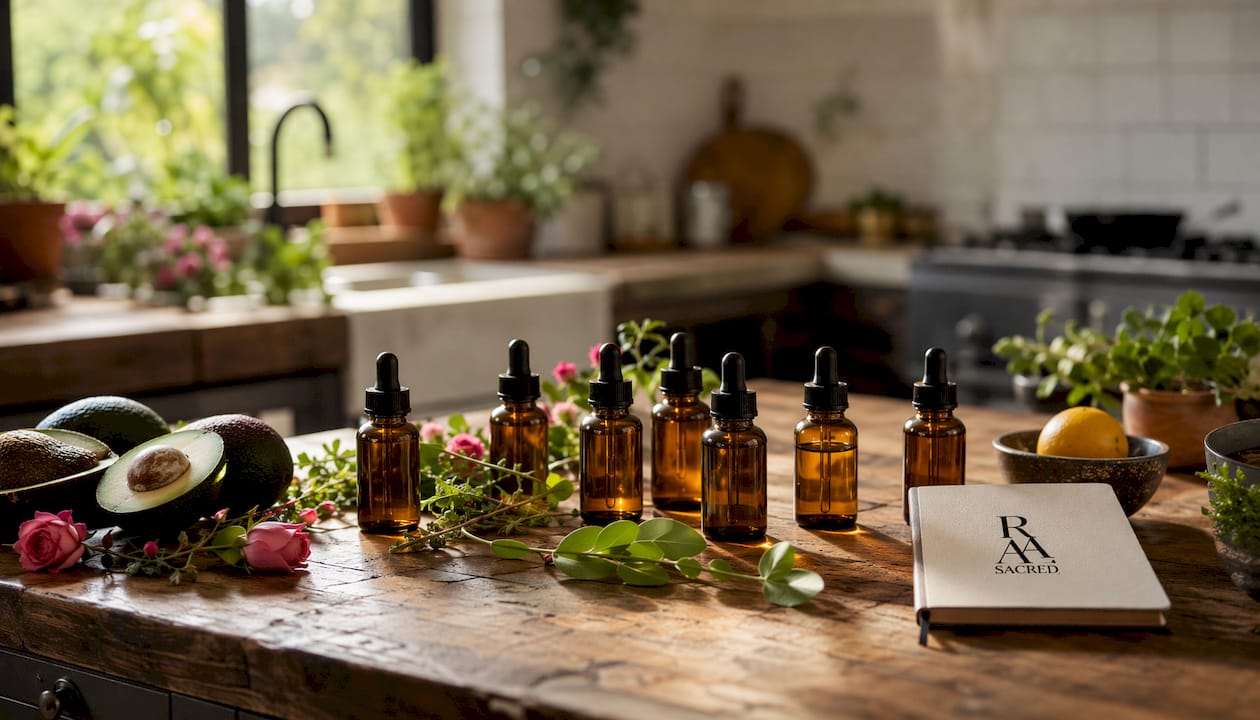
Familiar examples include jojoba, argan, rosehip, grapeseed, sweet almond, avocado, and coconut oil. Each has a distinct fatty-acid fingerprint that determines how it behaves on your skin.
Why use carrier oils? The real benefits go beyond dilution
The most common misconception is that carrier oils are passive vehicles, neutral bases you add just to thin out an essential oil. Practitioners emphasize that carrier oils are active ingredients. They determine absorption speed, skin feel, and long-term effects on the moisture barrier. The carrier defines the user experience as much as the essential oil defines the aromatic effect.
Here is what carrier oils actually do for skin:
- Emollience and softening: Carrier oils fill the gaps between skin cells, smoothing rough texture and reducing water loss through the skin surface.
- Barrier reinforcement: Lipid-rich oils replenish the skin’s natural lipid matrix, which is the physical structure that keeps moisture in and irritants out.
- Nutrient delivery: Fat-soluble vitamins (A, E, K) and antioxidants travel into the skin dissolved in the oil’s lipid phase, something water-based serums cannot do as efficiently.
- Safe essential-oil delivery: Carrier oils dilute concentrated essential oils to a safe working percentage, reducing irritation and sensitization risk.
- Texture and finish control: The oil you choose determines whether your finished product feels dry and silky, or rich and protective. That affects whether you actually use the product consistently.
Pro Tip: Treat your carrier oil as an active choice, not a neutral filler. If your goal is oil control, reach for grapeseed or jojoba. If it is barrier repair, choose avocado or argan. The carrier is doing half the skincare work.
How do carrier oils work on your skin?
Fatty-acid profiles drive everything
Fatty-acid composition is the primary axis for predicting how an oil absorbs, feels, and holds up over time. Oleic acid (omega-9) is a monounsaturated fat that penetrates deeply, feels rich, and suits dry or mature skin. Linoleic acid (omega-6) is a polyunsaturated fat that absorbs faster, feels lighter, and is the preferred fatty acid for oily or acne-prone skin because it supports the skin barrier without adding heaviness.

Polyunsaturated fatty acids (PUFAs) beyond linoleic, such as alpha-linolenic acid (ALA) in rosehip and flaxseed, are highly bioactive but oxidize quickly. That is the trade-off: the more unsaturated the oil, the more skin-compatible it tends to be, and the faster it goes rancid.
Comedogenic ratings: useful, but not gospel
Comedogenic ratings score oils from 0 (non-comedogenic) to 5 (highly likely to clog pores). Jojoba oil carries a comedogenic rating of 0 and closely resembles human sebum in structure, which is why it suits almost every skin type including oily and acne-prone. Coconut oil scores a 4, making it a poor choice for facial use on breakout-prone skin, though it works well on the body.
Treat comedogenic ratings as a screening tool, not a verdict. Individual skin chemistry varies, and a rating-2 oil may work perfectly for one person and cause breakouts in another. Patch-testing remains the only reliable personal test.
Penetration enhancement: the mechanism that matters most
Carrier oils can act as transdermal penetration enhancers by temporarily fluidizing the lipids in the stratum corneum, the outermost skin layer. This increases the absorption of lipophilic actives carried in the oil phase. It also means that whatever is dissolved in your carrier oil, including any contaminants in a low-quality product, gets a faster route into skin. Sourcing clean, well-processed oils is not a luxury preference; it is a safety consideration.
A note on oxidation: High-PUFA oils like rosehip, hemp seed, and evening primrose oxidize faster than oleic-dominant oils like argan or avocado. Oxidized oil on skin generates free radicals, which can accelerate the same aging it was meant to prevent. Store these oils in amber glass, keep them cool, and use them within six months of opening.
How do you choose the right carrier oil for your skin?
The right carrier oil depends on four variables: skin type, use case, finish preference, and how long the product needs to stay stable. Work through these in order.
-
Identify your skin type. Oily or combination skin does best with linoleic-dominant, low-comedogenic oils: jojoba, grapeseed, or squalane. Dry or mature skin benefits from oleic-rich options: argan, avocado, or sweet almond. Sensitive skin needs simple, low-fragrance oils with minimal processing, such as fractionated coconut or squalane.
-
Define the use case. Facial oils need fast absorption and low comedogenicity. Body oils can be richer and slower-absorbing. Massage oils need good slip and a longer working time, which favors oleic-dominant oils like sweet almond or olive.
-
Decide on finish. Do you want a dry, matte finish or a dewy, protective one? Grapeseed and jojoba absorb almost completely. Avocado and olive leave a noticeable film. Most people prefer a blend that lands somewhere in between.
-
Factor in stability. If you are making a batch that will sit for months, avoid high-PUFA oils unless you add a stabilizer. Adding 0.5–1% vitamin E (tocopherol) to blends with unstable oils helps delay oxidation and extends shelf life meaningfully.
-
Check for nut allergies. Sweet almond, macadamia, and walnut oils are tree-nut derived. If you have a nut allergy, choose seed-derived alternatives like grapeseed, sunflower, or hemp seed oil.
-
Consider layering. If the oil will sit under a water-based serum or sunscreen, choose a fast-absorbing option. A rich, slow-absorbing oil under SPF creates a slippery base that reduces sunscreen adhesion.
Red flags to avoid: strong natural fragrance in an unrefined oil (a sensitization risk for reactive skin), high polyunsaturate content with no antioxidant added, and a comedogenic rating above 3 for regular facial use.
What are the best carrier oils for skin?
The table below covers the most common carrier oils by skin type, absorption feel, comedogenic guidance, key fatty acids, stability, and scent. Use it to narrow down to one or two candidates, then patch-test.
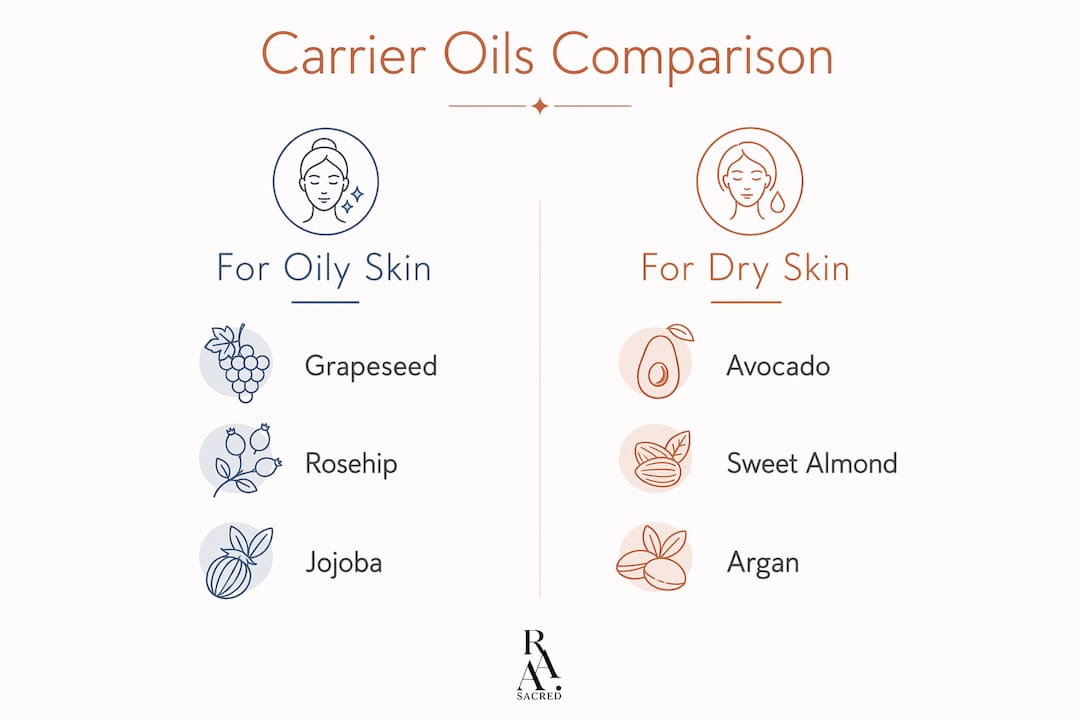
| Carrier oil | Best for | Absorption / feel | Comedogenic rating | Key fatty acids | Stability / shelf life | Scent |
|---|---|---|---|---|---|---|
| Jojoba | All skin types, oily, acne-prone | Dry, fast | 0 | Wax esters (mimics sebum) | Excellent (2+ years) | Faint, neutral |
| Grapeseed | Oily, combination, acne-prone | Dry, very light | 1 | High linoleic | Moderate (6 months) | Neutral |
| Argan | Dry, mature, normal | Medium, silky | 0–1 | Oleic + linoleic, vitamin E | Good (12 months) | Faint, nutty |
| Rosehip | Mature, hyperpigmentation, scarring | Medium, absorbs well | 1 | High linoleic + ALA | Low (3–6 months) | Earthy, mild |
| Sweet almond | Dry, sensitive, body | Medium, smooth | 2 | Oleic-dominant | Good (12 months) | Faint, sweet |
| Avocado | Dry, mature, eczema-prone | Rich, slow | 3 | High oleic, vitamins A/E | Good (12 months) | Mild, green |
| Coconut (fractionated) | Sensitive, massage, body | Light, silky | 1–2 | Caprylic/capric (MCT) | Excellent (2+ years) | Neutral |
| Coconut (virgin) | Body, dry skin, hair | Rich, occlusive | 4 | High lauric | Good (18 months) | Coconut |
| Olive | Dry, mature, body, massage | Rich, slow | 2 | High oleic | Moderate (12 months) | Grassy, distinct |
| Squalane | All types, sensitive, minimal routines | Dry, invisible | 0–1 | Stable hydrocarbon | Excellent (2+ years) | Odorless |
| Seabuckthorn | Mature, damaged, spot use only | Used at 1–3% | N/A | Omega-7, carotenoids | Low (3–6 months) | Strong, earthy |
A few standouts worth calling out: squalane and fractionated MCT are the go-to choices when you need a predictable, odorless finish with minimal oxidation risk, which makes them ideal for sensitive skin or minimalist routines. Seabuckthorn is in a different category entirely. It is used as a potent booster at 1–3% due to its intense orange color and high carotenoid content; at that level it adds meaningful antioxidant benefit without staining the skin.
For more on selecting carrier oils by use case, Raasacred’s blending guide covers the selection logic in more depth.
How to use carrier oils safely and mix them well
Dilution ratios for essential oils
Applying essential oils undiluted increases the risk of immediate irritation and long-term acquired sensitization. Even when no immediate reaction occurs, repeated undiluted use can cause delayed allergic responses that are difficult to reverse. Dilution is not optional.
| Use case | Dilution % | Drops of EO per 10 ml carrier |
|---|---|---|
| Adult face (daily use) | 1–2% | 3–6 drops |
| Adult body (daily use) | 2–3% | 6–9 drops |
| Massage oil | 2–3% | 6–9 drops |
| Sensitive skin / elderly | 0.5–1% | 1–3 drops |
| Aromatherapy roll-on | 2–5% | 6–10 drops |
| Spot application (short term) | Up to 5% | Up to 10 drops |
For a deeper look at essential oil dilution ratios, the Raasacred blending ratios guide covers beginner-friendly breakdowns.
Step-by-step application
- Cleanse and lightly dampen skin. Carrier oils seal in moisture better when skin is slightly damp, not soaking wet.
- Dispense 3–5 drops into your palm for facial use; 1–2 teaspoons for body use.
- Warm between palms for 5 seconds to improve spreadability and absorption.
- Press gently into skin rather than rubbing. This reduces friction and improves penetration.
- Layer water-based products first if you use serums. Oil goes on after water-based layers because it seals them in. Sunscreen goes on last, over everything.
- Wait 60–90 seconds before applying sunscreen or makeup to let the oil partially absorb.
Blending two carrier oils
Blending an oleic-dominant oil with a linoleic-dominant oil produces a finish that more closely mimics the skin’s own sebum than either oil alone. A practical starting point: 70% jojoba (linoleic/wax) plus 30% argan (oleic) for combination skin. For dry skin, flip the ratio: 70% argan or avocado, 30% rosehip. This approach, recommended by formulation practitioners, balances absorption speed with nourishment.
Pro Tip: Before committing to a new carrier oil on your face, apply a small amount to the inside of your forearm, cover with a bandage, and check at 24 and 48 hours. Look for redness, itching, or small bumps. This catches contact sensitivities before they reach your face.
What are the safety risks of carrier oils?
Sensitization from undiluted essential oils
The most common carrier-oil-adjacent safety error is skipping dilution. Neat essential oil application causes immediate irritation in many people and, more insidiously, can build sensitization over time. Once sensitized, the immune system reacts to even trace amounts of that essential oil, and there is no cure. Diluting in a carrier oil is the single most effective preventive measure. For guidance on topical essential oil safety, the application guide covers the full protocol.
Rancidity and oxidation
Signs of rancidity: a sharp, paint-like, or sour smell; a change in color toward darker yellow or orange; cloudiness in oils that are normally clear. Prevention is straightforward: store high-PUFA oils (rosehip, hemp seed, evening primrose) in small amber glass bottles in a cool, dark place, and use them within six months of opening. Adding 0.5–1% tocopherol to a blend with unstable oils extends shelf life without changing the skin feel.
Nut allergies and skin reactions
Sweet almond, macadamia, hazelnut, and walnut oils come from tree nuts. If you have a diagnosed nut allergy, avoid these and choose seed-derived alternatives. Even without a known allergy, patch-testing any new oil before full facial use is the standard precaution.
Interactions with actives
If you use prescription retinoids or strong exfoliating acids, apply them on clean skin before your carrier oil, not mixed into it. Carrier oils can enhance penetration of whatever is dissolved in them, which can intensify the effect of actives beyond what is comfortable or safe.
What experts get right about carrier oils that most guides miss
Carrier oils are not fillers
A key misconception persists across skincare content: that carrier oils are passive bases, neutral backgrounds for the “real” active ingredients. Aromatherapy and skincare experts are clear on this. The carrier oil determines absorption speed, texture, and long-term effect on the moisture barrier. A poorly chosen carrier undermines a well-chosen essential oil blend. The carrier is not the background; it is half the formula.
Penetration enhancement is real and worth understanding
A systematic review published in Pharmacy identified vegetable carrier oils as effective penetration enhancers in pharmaceutical formulations, with fatty-acid composition driving the enhancement effect. Oils high in unsaturated fatty acids are more likely to fluidize stratum corneum lipids, increasing absorption of lipophilic actives. This is why a well-formulated facial oil can deliver fat-soluble vitamins more efficiently than a water-based serum. It also explains why oil quality and purity matter: the same mechanism that carries beneficial actives deeper into skin will carry contaminants along for the ride.
For a closer look at how oils penetrate skin, the science behind lipid bilayer interactions is worth understanding before you build a routine.
Micro-dosing potent boosters
Seabuckthorn is the clearest example of an oil that requires a formulator’s mindset. At 1–3%, it contributes meaningful carotenoid and omega-7 content. At 10%, it turns skin orange and overwhelms the blend. The same logic applies to any high-potency oil: use it as a booster, not a base. Sonophoresis and other advanced topical delivery methods take this principle further, using ultrasound to drive actives through the skin barrier, but for most home routines, getting the fatty-acid balance right in your carrier blend is the more practical lever.
Key Takeaways
Carrier oils are active skincare ingredients, not neutral bases, and selecting the right one by fatty-acid profile and skin type is the single most important formulation decision you will make.
| Point | Details |
|---|---|
| Choose by fatty-acid profile | Linoleic-rich oils suit oily and acne-prone skin; oleic-rich oils suit dry and mature skin. |
| Dilute essential oils every time | Use 1–2% for facial application (3–6 drops per 10 ml) to prevent sensitization and irritation. |
| Patch-test before full use | Apply to the inner forearm for 24–48 hours and check for redness or itching before using on your face. |
| Store high-PUFA oils carefully | Use amber glass, cool storage, and add 0.5–1% tocopherol to slow oxidation in unstable blends. |
| Raasacred Sacred Bloom | A pre-formulated skin layering oil for readers who want a balanced, tested carrier-oil blend ready to use. |
A practical perspective on choosing carrier oils
Choosing a carrier oil well is one of those decisions that looks minor until you get it wrong. At Raasacred, the approach to carrier selection starts with the skin type and the goal, not the trend. The formulas behind products like Sacred Bloom reflect the same logic this guide lays out: balance oleic and linoleic fatty acids, keep the comedogenic rating appropriate for facial use, and build in oxidative stability so the product performs from the first drop to the last.
The practical advice here is to pick one carrier oil, use it consistently for two weeks under your normal routine, and pay attention to how your skin responds. One variable at a time is how you learn what actually works for your skin, not what works in theory.
Raasacred Sacred Bloom: a ready-made carrier-oil option
If you have read this far and want to skip the blending trial-and-error, Raasacred’s Sacred Bloom skin layering oil is a pre-formulated facial oil built around the fatty-acid balance principles covered in this guide. It is designed for daily facial layering, absorbs without a greasy finish, and combines 100% pure botanical carrier oils selected for compatibility across skin types.
This is Raasacred’s own product, disclosed as such. It is a strong fit for readers who want a balanced, all-purpose facial oil without sourcing and blending individual carriers. For body and massage use, the botanical body oil collection covers richer, slower-absorbing options suited to those applications. Visit the Sacred Bloom product page to see the full ingredient list and choose the routine that fits your skin type.
Useful sources and further reading
The claims in this guide draw on the following sources. Each is worth reading if you want to go deeper on a specific topic.
- ACS Omega: Plant-Based Cosmetic Oils Review — Peer-reviewed review of the chemical and biological properties of coconut, olive, argan, and jojoba oils; supports the fatty-acid and emollience claims throughout this guide.
- MDPI Pharmacy: Systematic Review on Penetration Enhancers — Academic systematic review identifying carrier oils as penetration enhancers in pharmaceutical formulations; supports the absorption-mechanism section.
- NCBI PMC: Skin Barrier and Lipid Research — Research on skin lipid composition and barrier function; relevant to the fatty-acid and barrier-support discussion.
- PMC: Topical Oil and Skin Health — Clinical research on topical oil application and skin outcomes; supports barrier-reinforcement claims.
- Plant Therapy: Why Not to Apply Essential Oils Neat — Practitioner explanation of sensitization risk from undiluted essential oil use; supports the dilution safety section.
- ACHS: Carrier Oils Guide — Aromatherapy practitioner guide emphasizing carrier oils as active ingredients; supports the EEAT and “why use” sections.
- The Skin Science Company: Carrier Oils for DIY Skincare — Formulator-level guide covering fatty-acid profiles, comedogenicity, and blending ratios; supports the selection framework and comparison table.
- Natural Skincare Ingredients: Complete Carrier Oil Guide — Formulator’s reference on carrier oil behavior, absorption classification, and blending strategy.
- Raasacred: Seed Oils in Natural Formulas — Brand editorial on seed-derived carrier oils and their formulation roles; useful companion reading for the popular-oils section.
- Raasacred: Botanical Oils for Aging Skin — Evidence-backed discussion of carrier oil selection for mature skin concerns.