

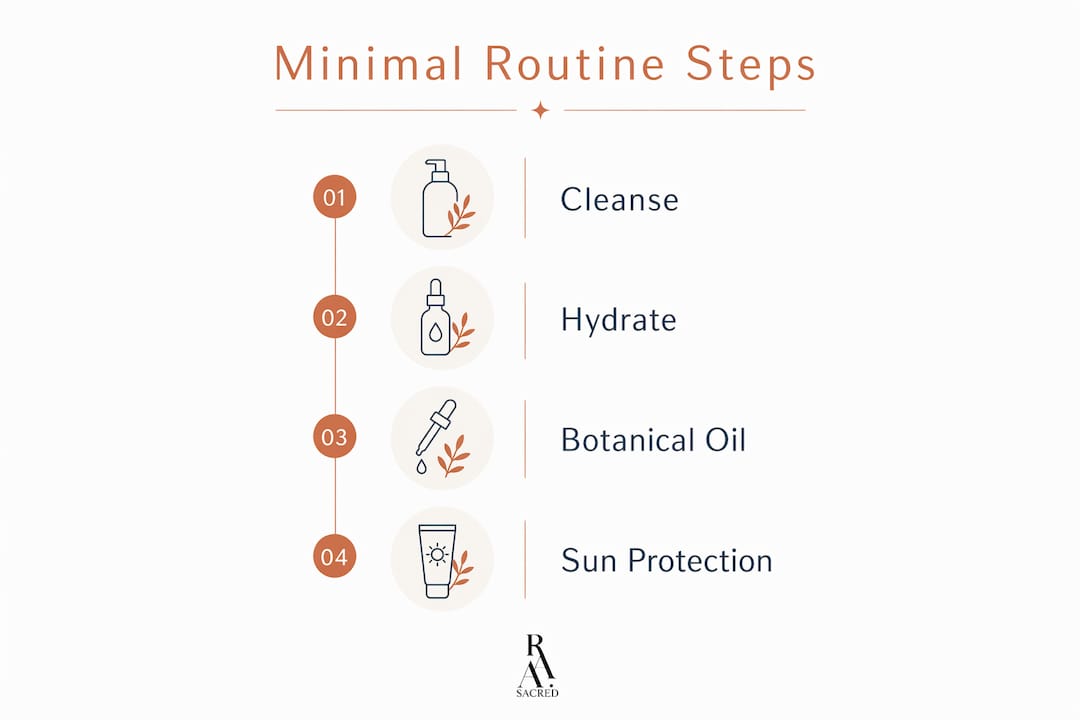
Building minimal natural skincare means selecting four effective botanical steps, removing every redundant active, and letting your skin barrier do its job. The daily body routine is this simple: cleanse gently, apply a humectant or hydrating serum, layer a carrier or essential-oil body oil, and finish with sun-aware protection in the morning. Dermatology guidance frames this as barrier-first care, not deprivation. Raasacred’s Sacred Bloom is one ready-made option for the oil step. Start today by patch-testing one carrier oil on your inner forearm for 24 hours.
- Cleanse: one gentle, non-stripping body wash, once daily
- Hydrate: a humectant layer (glycerin, hyaluronic acid, or aloe) applied to damp skin
- Oil/moisturize: a botanical body oil or balm sealed over the hydrating layer
- Protect: broad-spectrum SPF in the morning, or stay sun-aware if you skip it
Table of Contents
- What “minimal natural skincare” actually means for body care
- Which products belong in a minimal botanical body kit?
- How to choose essential oils and carrier oils that fit your skin
- Safety rules you need to follow before using essential oils on your body
- Your step-by-step daily and weekly ritual
- How to transition from a full routine to a minimal one
- What to look for when buying natural botanical body care
- What a minimalist natural body routine actually costs
- Raasacred Sacred Bloom fits a minimalist ritual naturally
- Key Takeaways
- The case for fewer products and more intention
- Useful sources and further reading
What “minimal natural skincare” actually means for body care
Minimal natural skincare is not the “caveman” approach of washing with water and hoping for the best. It is doing exactly enough: using the fewest products that support your skin barrier without creating ingredient conflicts. Dermatologists consistently point out that eliminating redundant products makes it far easier to track what is actually working and to avoid the cumulative irritation that comes from layering too many actives.
Body skin differs from facial skin in volume, surface area, and typical concerns. It tolerates richer textures and higher oil concentrations, but it is also more likely to be neglected entirely or overwhelmed with thick, fragrance-heavy products. A minimalist body routine prioritizes barrier-supporting lipids, a single humectant, and a gentle cleanser over a shelf of competing serums.
Pro Tip: Prioritize ceramide-rich or lipid-rich oils over products that stack multiple actives. One well-chosen carrier oil does more for body skin than three serums fighting each other for absorption.
Which products belong in a minimal botanical body kit?
A minimal kit has four slots. Fill each one deliberately, and resist the urge to add a fifth.
- Gentle body cleanser (daily): a pH-balanced, sulfate-free wash that does not strip the skin. Use it once daily, or only at night if your skin runs dry.
- Humectant treatment (daily, on damp skin): a water-based serum, aloe vera gel, or glycerin-forward mist applied immediately after showering. This is the hydration layer.
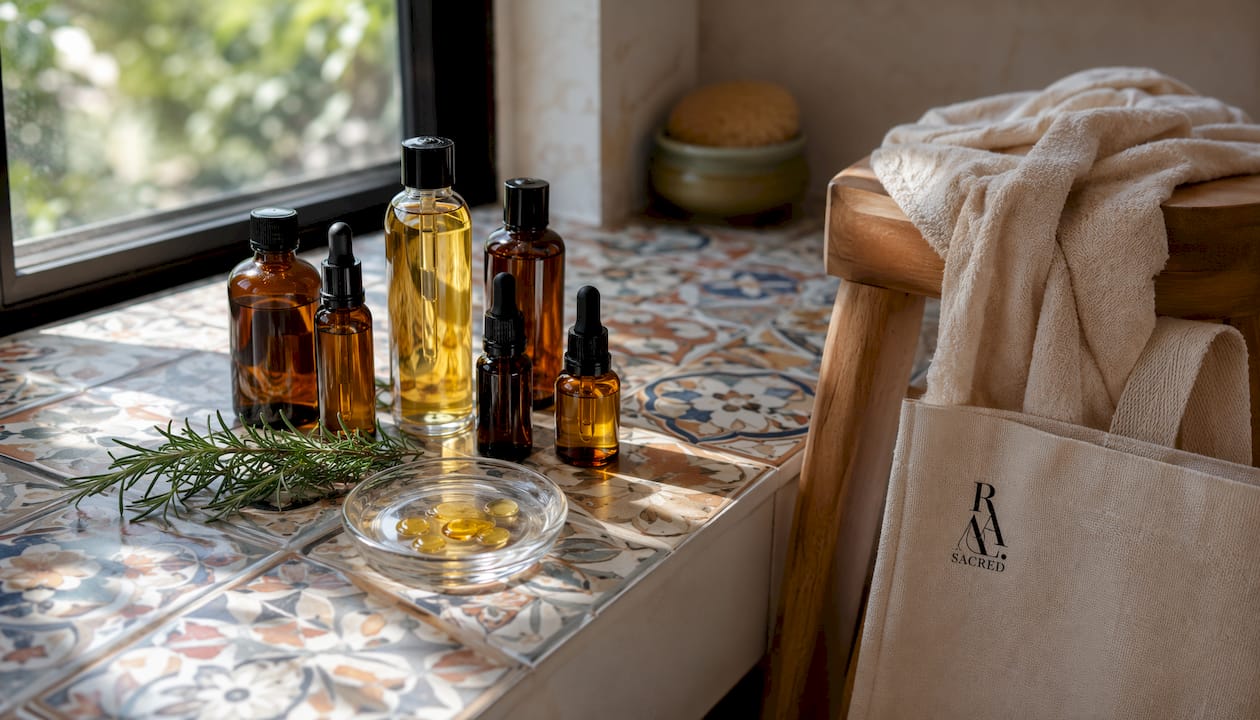
- Botanical body oil (daily): a carrier or essential-oil blend sealed over the humectant while skin is still slightly damp. Seed oils like jojoba, squalane, and rosehip are the workhorses here.
- Weekly treatment (1–2x per week): a mild physical or enzyme exfoliant, or a hydrating body mask for elbows, knees, and rough patches.
Skip multiple body serums, overlapping exfoliants, and any product that duplicates what another already does. For ritual feel, a light dry oil absorbs in under a minute; a richer balm suits nighttime or very dry skin.
Body oil benefits go beyond surface moisture — the right oil reinforces the lipid barrier and leaves skin noticeably softer within a week of consistent use.
How to choose essential oils and carrier oils that fit your skin
Pick one non-comedogenic carrier oil as your base, then add one or two low-risk essential oils for scent and targeted benefit, as explained in why natural ingredients matter in beard care on Ironwood Grooming’s blog. That combination covers the oil step without overloading your skin.
Carrier oil profiles:
| Oil | Best for | Comedogenic risk | Absorption |
|---|---|---|---|
| Jojoba | All types, oily/acne-prone | Very low | Fast, dry finish |
| Squalane | Sensitive, mature, dry | Very low | Fast, silky |
| Rosehip | Dry, uneven tone | Low–moderate | Medium |
| Sweet almond | Normal to dry | Low | Medium |
Jojoba’s composition closely mirrors skin sebum, which is why it absorbs cleanly without clogging pores. Squalane, the stabilized form of naturally occurring squalene, supports the lipid barrier and suits sensitive or mature skin particularly well. Rosehip brings antioxidant and anti-inflammatory properties but is heat-sensitive, so store it away from light.
For essential oils, lavender is the lowest-risk starting point: calming, widely tolerated, and effective at low concentrations. Frankincense supports skin tone and has a grounding, resinous scent that suits a wellness ritual. Both work at 1–2% dilution in a carrier oil for body use. Explore floral essential oil profiles if you want to expand your scent palette without adding complexity.
One note: “natural” does not mean gentle. Essential oils are active ingredients. Treat them with the same discipline you would any cosmetic active.
Safety rules you need to follow before using essential oils on your body
Essential oils are potent, and the rules below are not optional.
Dilution for body use: 1–3% is the standard adult range for leave-on body products. For facial use, stay at 0.5–1%. For children under 10 or during pregnancy, consult a clinician before using any essential oil beyond lavender at very low concentrations.
Photosensitizing oils to avoid before sun exposure: bergamot (unless bergapten-free), lemon, lime, grapefruit, and most cold-pressed citrus oils. Apply these only at night or on covered skin.
Patch-test protocol: apply your diluted blend to the inner forearm, cover loosely, and leave for 24–48 hours before broader use. A “clean” label does not change this step.
Shelf life and storage: most carrier oils last 6–18 months. Rosehip and other high-linoleic oils oxidize faster; refrigerate them. Keep all oils away from direct light and heat. A rancid oil smells noticeably off and should be discarded, not used.
Pro Tip: Label every DIY blend with the date you made it and the dilution percentage. A 30-second habit that prevents you from using an expired or over-concentrated product months later.
Your step-by-step daily and weekly ritual
The thinnest-to-thickest rule governs every layering decision. Apply lighter, water-based products first; seal with oil last. Reversing this order blocks absorption.
Daily AM routine (5–7 minutes):
- Rinse or gently cleanse in the shower.
- Pat skin to damp, not dry.
- Apply 2–3 pumps of humectant serum or aloe gel to body while skin is still warm.
- Follow immediately with 4–6 drops of body oil, pressed in with palms.
- Apply SPF to exposed areas before dressing.
Daily PM routine (3–5 minutes):
- Cleanse to remove the day’s buildup.
- Apply humectant layer to damp skin.
- Seal with body oil or a richer balm for overnight repair.
Weekly add-ons:
- Mild enzyme or sugar scrub on elbows, knees, and heels (1–2x per week, never on broken skin)
- Hydrating body mask or a heavier occlusive on very dry patches
Pro Tip: Keep your body oil on the shower shelf. The 30-second window after stepping out, while skin is still warm and damp, is when oil absorbs most effectively. Miss that window and you get surface shine instead of real hydration.
Pair this with botanical beauty rituals to build sensory cues that make the routine feel like self-care rather than maintenance.
How to transition from a full routine to a minimal one
Move slowly. Introduce one product at a time and wait 14 days before adding or removing anything else. That two-week buffer is the only reliable way to know whether a product is helping or causing a reaction.
A conservative transition plan:
- Week 1–2: Keep only your cleanser and one moisturizer. Remove everything else.
- Week 3–4: Introduce your chosen carrier oil. Observe.
- Week 5–6: Add one essential oil at your target dilution. Patch-test first.
- Week 7+: Add the weekly exfoliant if skin is stable.
Signs your skin is improving: less tightness after cleansing, more even hydration through the day, reduced redness or random bumps.
Signs of barrier stress: persistent dryness that worsens, new sensitivity to products that previously caused no reaction, redness that does not resolve within 48 hours.
If barrier stress appears, strip back to cleanser and moisturizer only for 7–14 days. Reintroduce the last product you added first, since that is the most likely cause.
Keep a simple log: product name, date introduced, any reaction. Three columns in a notes app is enough.
What to look for when buying natural botanical body care
The label tells you almost everything, if you know what to read.
- INCI listing: ingredients must appear by their standardized International Nomenclature of Cosmetic Ingredients names, in descending order of concentration. If a brand hides this, move on.
- Dilution transparency: for essential-oil products, the percentage or drop count should be stated or available on request.
- Batch and expiry: natural formulas without synthetic preservatives have shorter shelf lives. A batch number and best-before date are non-negotiable.
- Third-party testing: not universal, but a meaningful trust signal for purity claims.
- Preservative strategy: any water-containing product needs a preservative. The absence of one is a contamination risk, not a selling point.
On label claims: “natural” has no regulated federal definition in the U.S. “Organic” is regulated by the USDA when applied to agricultural ingredients. “Clean” means whatever the brand decides it means. Ingredient transparency and clear sourcing matter far more than any of these marketing terms.
Pro Tip: Search the brand’s INCI list on the EWG Skin Deep database before buying. It takes two minutes and surfaces any flagged ingredients the marketing copy glosses over.
For organic ingredient sourcing context, the role of organic ingredients in body care is worth reading before you shop.
What a minimalist natural body routine actually costs
| Budget tier | Monthly estimate | What it covers |
|---|---|---|
| Entry | — | Drugstore gentle cleanser, glycerin or aloe, one carrier oil (jojoba or sweet almond) |
| Mid | — | Clean-brand cleanser, quality humectant serum, one premium carrier oil |
| Premium | — | Artisan or botanical-brand cleanser, multi-use serum, premium essential-oil body oil blend |
A 30ml body oil used daily at 4–6 drops per application lasts roughly 6–8 weeks. Time commitment runs 5–7 minutes in the morning and 3–5 minutes at night. The ritual value, a few quiet minutes of intentional self-care, is harder to price.
To reduce cost without cutting safety: choose multi-use products (a body oil that doubles as a hair treatment), buy carrier oils in 100ml bottles rather than 30ml, and skip the weekly treatment until your base routine is stable.
Raasacred Sacred Bloom fits a minimalist ritual naturally
A minimalist essential-oil routine works best when the oil step is already formulated correctly: the right dilution, a non-comedogenic carrier base, and a scent profile designed for daily use. That is exactly what Raasacred built Sacred Bloom to be.
Sacred Bloom is a skin layering oil that slots directly into the oil step of the routine above. It combines 100% pure essential oils with carefully selected carrier oils for a non-greasy, soak-in finish. The scent profile is warm and botanical, designed to make the application feel like a ritual rather than a chore. Use 4–6 drops pressed into damp skin immediately after your humectant layer. Patch-test on your inner forearm for 24–48 hours before full-body use.
For readers who want to explore different skin fits and scent directions, Raasacred’s botanical body oils collection offers a curated range matched to different skin needs and ritual preferences, all formulated with the same transparency and purity standard.
Key Takeaways
A minimal botanical body routine built on barrier-first principles, correct layering order, and the two-week introduction rule delivers better results than a shelf full of competing actives.
| Point | Details |
|---|---|
| Four-step framework | Cleanse, humectant, botanical oil, and SPF cover every body care need without ingredient conflicts. |
| Thinnest to thickest | Apply water-based layers before oil; reversing the order blocks absorption and wastes product. |
| Two-week rule | Introduce one new product at a time and wait 14 days before adding another to isolate reactions. |
| Dilution is non-negotiable | Essential oil concentration for adult body leave-on products should be 1–3%; always patch-test 24–48 hours first. |
| Raasacred Sacred Bloom | A pre-formulated layering oil that fills the oil step of a minimalist ritual with correct dilution and a botanical scent profile. |
The case for fewer products and more intention
The conventional wisdom in skincare is that more steps equal more results. It does not. What actually moves the needle is consistency with a short, well-chosen routine, and the sensory quality of that routine matters more than most guides admit.
A ritual that feels good gets repeated. A seven-step routine that feels like a chore gets abandoned by week three. Choosing a body oil with a scent you genuinely love, applying it to warm, damp skin for 60 seconds, and breathing it in — that is not indulgence. That is the mechanism by which a routine becomes a habit. The holistic beauty approach recognizes this: skincare that supports wellbeing is not separate from skincare that supports skin health. They are the same thing.
The one thing most minimalist guides understate is how much the transition period matters. Stripping back a full routine too fast causes barrier stress that looks like a product failure. Slow down, use the two-week rule, and give your skin time to recalibrate. The results, when they come, are unmistakable.
Useful sources and further reading
The claims in this guide draw on the following sources. Each is worth reading directly if you want to go deeper on any section.
- FoxHall Dermatology: Minimalist Skincare: dermatology-backed case for barrier-first minimalism, patch-testing protocols, and essential oil cautions.
- Everyday Health: Minimalist Skin-Care Routines: clinician guidance on why fewer products improve adherence and make results easier to track.
- Curology: The Minimalist Routine: four-step clinical framework and the value of consolidating actives.
- School of Natural Skincare: Natural Ingredients Guide: formulator-level reference for carrier oils, essential oils, usage rates, and safety considerations.
- Nature’s Soul Shop: Minimalist Skincare Routines: practical layering order guidance and the two-week introduction rule.
- Formula Botanica: Science-Backed Natural Ingredients: ingredient profiles for jojoba, squalane, rosehip, and other carrier oils with formulation notes.
- Glowzey: Minimal, Clean & Organic Skincare Philosophy: context on ingredient transparency, organic sourcing, and the limits of “clean” label claims.