

A short aromatherapy self-massage using a properly diluted essential oil blend, typically around 1% concentration and slow effleurage strokes toward the heart can ease mild muscle tension and calm the nervous system in five minutes or less. You need three things: a carrier oil (like jojoba or sweet almond), one or two drops of a calming essential oil such as lavender or cedarwood, and a quiet spot to sit or lie down.
Start right now with these steps:
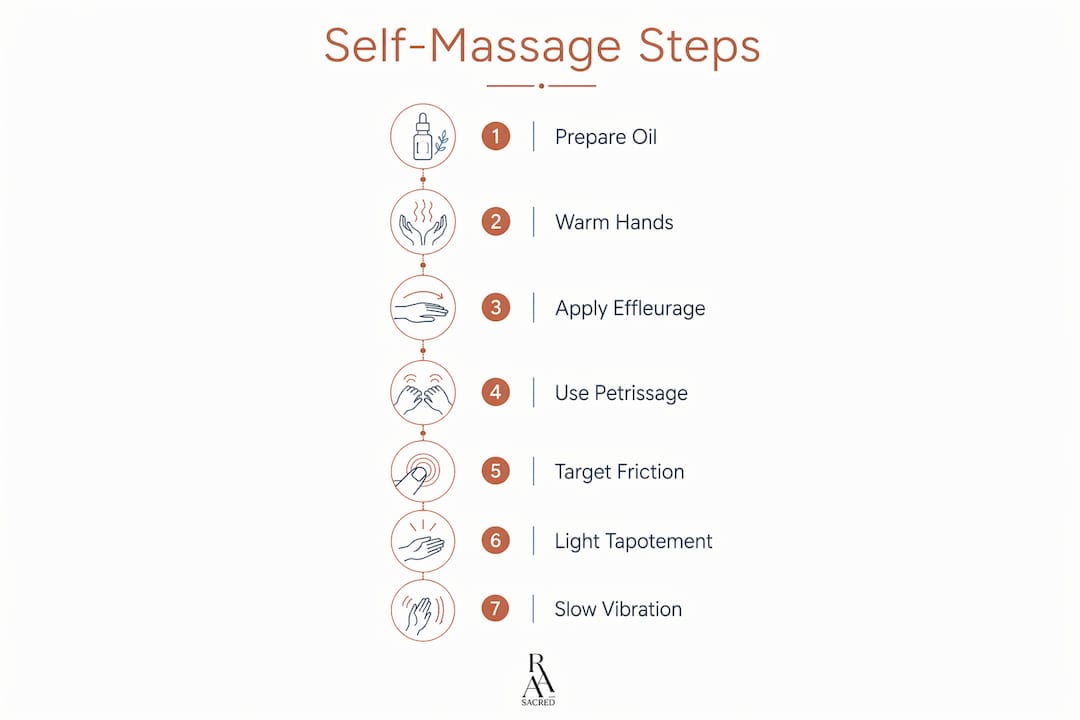
- Pour about a teaspoon of carrier oil into your palm and add approximately three drops of essential oil for a standard 1% dilution.
- Cup both hands together and hold to gently warm the blend.
- Inhale slowly through your nose before touching your skin.
- Use long, slow gliding strokes (effleurage) on your neck, shoulders, or hands, always moving toward your heart.
- Breathe out fully on each long stroke; repeat for 3–5 minutes.
Stop immediately if you feel any sharp or lasting pain, and wash the area if your skin reacts.
Pro Tip: Warming the oil in cupped hands for 10–30 seconds before applying it improves absorption and makes the whole experience noticeably more comfortable.
Table of Contents
- What is aromatherapy self-massage and how does it work?
- What benefits can you realistically expect?
- How do you dilute and use carrier oils safely?
- How do you blend essential oils for a relaxing massage?
- What are the core self-massage strokes and how do you use them?
- How do you set up your space and warm your oils?
- Three ready-to-follow aromatherapy self-massage routines
- When should you stop and see a clinician instead?
- What does the research actually say about aromatherapy massage?
- Key Takeaways
- Why self-massage sticks when you treat it like a ritual
- Sacred Bloom: a ready-made option for your self-massage routine
- Useful sources and further reading
What is aromatherapy self-massage and how does it work?
Aromatherapy self-massage combines two things that work better together than apart: the inhalation of essential oil scent and the topical application of a diluted blend during massage. Neither pathway alone delivers the full effect.
The olfactory pathway carries scent molecules from your nose through olfactory nerves directly to the amygdala, the brain’s emotional processing center. That’s why a single inhale of lavender can shift your mood before you’ve touched your skin. The dermal pathway adds a second layer: when you massage a diluted blend into your skin, a portion of the essential oil compounds absorbs transdermally, extending the effect beyond the initial scent hit.
Together, the two pathways explain why scent and touch are more effective in combination than either alone. The limbic system processes both the emotional signal from scent and the physical signal from touch, nudging the nervous system toward a parasympathetic (rest-and-digest) state.
A few key points about what this practice is and isn’t:
- It is a complementary health approach, not a replacement for medical treatment of chronic or diagnosed conditions.
- The essential oils must be properly diluted in a carrier oil before any skin contact, with clinical guidelines recommending a 1% concentration for full-body adult massage.
- Benefits come from consistent, short sessions rather than occasional long ones.
What benefits can you realistically expect?
The most well-supported benefit of regular aromatherapy self-massage is a reduction in everyday stress and mild muscle tension. Sleep quality, localized circulation, and day-to-day anxiety levels are also commonly reported improvements, though the strength of evidence varies by condition.
A map of the evidence published by the NCBI covering 26 systematic reviews found moderate-confidence evidence that aromatherapy benefits pain in dysmenorrhea, and low-to-moderate confidence for stress reduction in healthy adults, anxiety in perioperative patients, and sleep quality across various populations. For most other conditions, evidence is insufficient or inconsistent. That framing matters: aromatherapy self-massage is genuinely useful for relaxation and minor tension, but it is not a clinically proven cure for chronic pain or anxiety disorders.
What you can realistically expect:
- After a single session: reduced sense of tension in the worked area, a calmer mood, and easier breathing.
- After consistent daily practice (1–2 weeks): noticeable improvement in how quickly you wind down before sleep, and less postural tightness in the neck and shoulders.
- Circulation: gentle massage strokes improve local blood flow temporarily, which can reduce that heavy, stiff feeling in legs and arms.
The natural therapies review from Australia’s Department of Health (2024) reinforces this picture: moderate confidence for specific outcomes, with a consistent recommendation to use aromatherapy as a complement to, not a substitute for, conventional care.
Statistic to keep in mind: The NCBI evidence map covering 26 systematic reviews found moderate-confidence support for aromatherapy’s effect on stress in healthy adults and sleep quality across multiple populations — two of the most common reasons people try self-massage at home.
How do you dilute and use carrier oils safely?
Getting dilution right is the single most important safety step in any DIY aromatherapy massage. Essential oils are highly concentrated plant extracts. Applying them undiluted causes skin irritation, sensitization, and in some cases chemical burns.
Dilution rates for adults and children
Johns Hopkins Medicine recommends approximately 1% concentration for full-body massage in adults. For small-area work (a sore shoulder, the soles of the feet), 2% is acceptable for healthy adults. Children under 12, pregnant people, and those with sensitive skin should stay at 0.5–1%.
| Dilution | Drops per 1 tsp (5 mL) carrier oil | Use case |
|---|---|---|
| 0.5% | 1–2 drops | Children, sensitive skin, face |
| 1% | 3 drops | Full-body adult massage |
| 2% | 6 drops | Small-area adult work |
| 3% | 10 drops | Localized muscle tension (short-term) |
Patch testing
Apply a small amount of your diluted blend to the inside of your wrist or elbow. Wait 24 hours. If you see redness, itching, or swelling, that oil or carrier is not suitable for you. Patch test every new blend, not just new oils.
What to avoid
- Phototoxic oils (bergamot, cold-pressed lime, lemon): avoid applying to skin that will be exposed to sunlight within 12–18 hours.
- Strong irritants: cinnamon bark, clove, oregano, and thyme (thymol chemotype) are too aggressive for skin use at any practical dilution.
- Sensitive areas: never apply essential oils near eyes, mucous membranes, or open wounds.
- Undiluted application: no essential oil should touch skin without a carrier, regardless of the brand’s claims.
Pro Tip: Store blended oils in a dark glass bottle, label it with the blend date and dilution percentage, and use it within 3–6 months. Oxidized oils irritate skin and lose their therapeutic scent profile. Check out carrier oil options to find the right base for your skin type.
How do you blend essential oils for a relaxing massage?
The 30–50–20 rule gives beginners a simple framework for building a balanced, pleasant-smelling blend without any formal training. It refers to the proportion of top, middle, and base notes in a blend.
- Top notes (30%): the first scent you smell, bright and fleeting. Examples: sweet orange, lemon, bergamot (use the non-phototoxic steam-distilled version), peppermint.
- Middle notes (50%): the heart of the blend, lasting longer. Examples: lavender, geranium, Roman chamomile, clary sage.
- Base notes (20%): the anchor, slow to evaporate, grounding. Examples: cedarwood, sandalwood, frankincense, vetiver.
For a 10-drop relaxation blend in 1 tsp (5 mL) of carrier oil at 2%:
- 3 drops sweet orange (top)
- 5 drops lavender (middle)
- 2 drops cedarwood (base)
That’s it. Beginners do best with 1–3 oils rather than complex multi-oil formulas. More oils don’t mean more benefit; they increase the chance of a sensitizing reaction and make it harder to identify what’s working. For a deeper look at floral oil pairings, Roman chamomile and lavender together are one of the most consistently calming combinations in the literature.
To adjust intensity: add one more drop of your dominant middle note if the scent feels too faint, or reduce by one drop if it feels sharp. Sensitivity varies widely, so trust your nose.
What are the core self-massage strokes and how do you use them?
Five strokes cover almost everything you need for a safe, effective home practice. Each has a distinct purpose, and knowing when to use which one keeps you from working too hard or in the wrong direction.
Pro Tip: Synchronize your long effleurage glides with a full exhale. The combination of slow movement and a long out-breath triggers the parasympathetic nervous system more effectively than either alone.
Effleurage
Long, gliding strokes with the flat of the hand or fingers. Always move toward the heart. This is your opening and closing stroke for every area. Use it to spread oil, warm the tissue, and transition between techniques. Pressure: light to medium.
Petrissage
Kneading and lifting the muscle tissue, like working dough. Best for fleshy areas: calves, thighs, the upper trapezius. It increases local circulation and begins to release deeper tension. Pressure: medium. Avoid bony areas entirely.
Friction
Small, deep circular movements using fingertips or thumbs, applied to a specific tight spot. Useful for the base of the skull, the space between shoulder blade and spine, and the arch of the foot. Keep circles small and controlled. Pressure: medium to firm, but never sharp pain.
Tapotement
Light rhythmic tapping or cupping with relaxed hands. Stimulating rather than relaxing, so use it sparingly in a relaxation routine. It’s most useful for waking up sluggish circulation in the legs or as a brief energizing finish. Pressure: very light.
Vibration
A fine trembling or shaking motion transmitted through the fingertips or palm. Calming when applied slowly; stimulating when fast. Slow vibration over the scalp or along the forearm is genuinely soothing and easy to self-apply.
The UMMS self-massage guide makes one rule non-negotiable: keep sweeping strokes moving toward the heart to assist venous return, and never press tools or fingers directly onto bones or joints.
How do you set up your space and warm your oils?
You don’t need much. The setup that actually gets used consistently is the one that requires the least friction.
Minimum equipment:
- A carrier oil or pre-blended body oil
- A small towel or cloth
- A comfortable chair (for neck and shoulders) or a yoga mat (for legs and feet)
- A small bowl of warm water to set your oil bottle in for 60–90 seconds before use
- A mirror for hard-to-see areas like the upper back
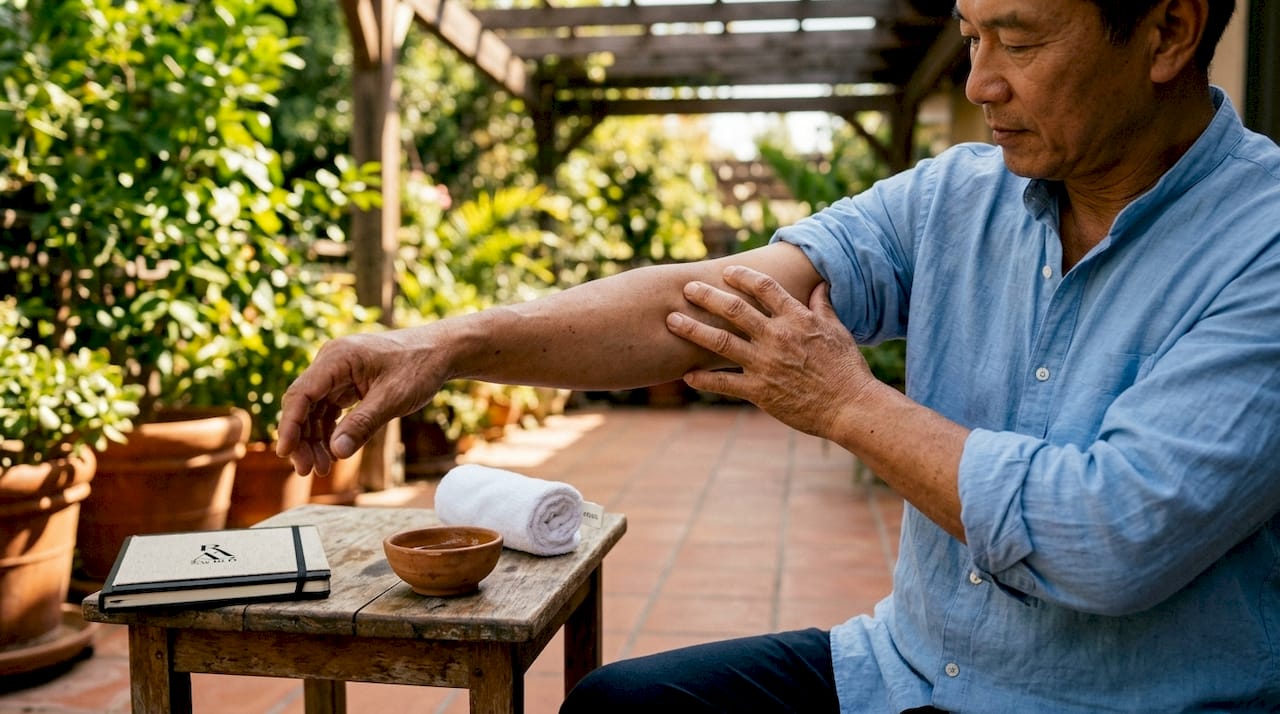
Warming the oil is worth doing every time. Practical guides recommend warming oil in cupped hands or a warm-water bowl for 10–30 seconds before application. Warm oil spreads more easily, absorbs faster, and the heat itself relaxes superficial muscle fibers before you’ve even started stroking.
Posture cues by area:
- Neck and shoulders: sit upright in a chair, feet flat on the floor, spine tall. Drop your chin slightly to access the base of the skull.
- Legs and feet: sit on a mat with legs extended, or cross one ankle over the opposite knee for foot work.
- Arms and hands: rest your forearm on a table or your thigh to reduce effort in the working hand.
Timing and frequency:
- 5 minutes: a quick reset during the workday or before bed.
- 10 minutes: targeted work on one area (neck and shoulders, or both feet).
- 15 minutes: a short full-body ritual covering multiple areas in sequence.
Short, consistent sessions are more effective long-term than infrequent, aggressive ones. Ten minutes daily beats a 45-minute session once a week for building the kind of cumulative relaxation response that actually changes how your body holds tension.
Three ready-to-follow aromatherapy self-massage routines
5-minute starter: hands, neck, and shoulders
- Warm 1 tsp blended oil in cupped hands. Inhale slowly twice.
- Interlace fingers and use thumbs to apply friction circles across the opposite palm for 30 seconds each hand.
- Glide both hands up the back of the neck with effleurage, from the base of the skull to the top of the shoulders, 6–8 slow strokes.
- Use fingertip friction in small circles at the base of the skull for 30 seconds.
- Finish with light effleurage across both shoulders, exhaling fully on each stroke.
Breathe slowly throughout. This routine is effective immediately after a long screen session.
10-minute neck and shoulders routine
- Warm oil and inhale. Begin with 2 minutes of effleurage across the upper back and shoulders.
- Move to petrissage on the upper trapezius: lift and knead the muscle between thumb and fingers for 90 seconds per side.
- Apply friction circles with fingertips along the spine-side edge of each shoulder blade, 60 seconds per side.
- Return to effleurage for 90 seconds, slower and lighter than the opening strokes.
- Finish with 30 seconds of slow vibration across the top of each shoulder, then two deep breaths.
Adjust pressure down if anything feels sharp. The goal is a “good ache,” not pain.
15-minute full-body short ritual
Follow this sequence order for best circulatory flow:
- Feet and calves (3 min): effleurage from ankle to knee, then petrissage on the calf belly.
- Thighs (2 min): long effleurage strokes toward the hip, medium pressure.
- Glutes (1 min): seated, use knuckle friction on the outer hip and glute.
- Lower back (2 min): standing or seated, use both fists to apply light friction circles on either side of the spine (never on the spine itself).
- Upper shoulders and neck (4 min): follow the 10-minute routine above, compressed.
- Arms and hands (2 min): effleurage from wrist to shoulder, then palm friction on each hand.
- Closing (1 min): two or three full body effleurage sweeps, very light, then three slow breaths.
End every routine with a gentle neck or wrist stretch and drink a glass of water. Massage temporarily increases local circulation and metabolic activity in worked tissue; hydration supports that process.
For body application techniques that extend beyond massage, the same oils work well in a post-shower ritual.
When should you stop and see a clinician instead?
Self-massage is safe for most healthy adults, but there are clear situations where it is not appropriate and where continuing could cause harm.
Stop immediately and seek care if you experience:
- Sharp, shooting, or lasting pain during or after massage
- Numbness or tingling that doesn’t resolve within a few minutes
- Rapid swelling in the worked area
- Dizziness or nausea
- A skin reaction: hives, significant redness, or blistering
Do not self-massage if you have:
- Recent surgery or open wounds in the area
- Undiagnosed lumps or swelling
- Acute inflammation or active infection
- Known or suspected deep vein thrombosis (DVT)
- Severe osteoporosis
- Active skin conditions (eczema flare, psoriasis, sunburn) in the target area
Pregnancy-specific caution: several essential oils are contraindicated during pregnancy, including clary sage, rosemary, and high-dose peppermint. Consult your OB or midwife before using any essential oil blend during pregnancy.
When to see a professional first:
- Chronic pain, neurological symptoms, or circulation disorders require a clinician’s assessment before self-massage.
- A licensed massage therapist or physical therapist is appropriate when tension is severe, persistent, or linked to a specific injury.
- If you take blood-thinning medication, check with your primary care provider before applying any pressure-based technique.
This article is general wellness information, not medical advice. Confirm the right approach for your specific situation with a qualified healthcare provider.
What does the research actually say about aromatherapy massage?
The mechanisms are well-established. Scent molecules reach the amygdala via olfactory nerves, directly influencing emotional state and stress response. Topical application during massage adds a dermal absorption route, and sustained pressure on muscle tissue stimulates mechanoreceptors that shift the nervous system toward parasympathetic activation, increasing tissue pliability and reducing perceived pain.
The clinical evidence is more mixed. The NCBI’s evidence map across 26 systematic reviews found:
- Moderate confidence: aromatherapy benefits pain in dysmenorrhea; tea tree oil applied topically shows positive effects for tinea pedis.
- Low to moderate confidence: stress reduction in healthy adults, improved sleep quality across various populations, anxiety reduction in perioperative patients.
- Insufficient evidence: most other conditions examined.
The National Center for Complementary and Integrative Health (NCCIH) describes aromatherapy as a complementary health approach, noting it is sometimes incorporated into massage therapy for conditions including knee pain from osteoarthritis and anxiety in people with cancer. Their framing is consistent: useful alongside conventional care, not instead of it.
For self-massage specifically, a PubMed review on self-massage techniques found that 10–20 minute sessions using appropriate tools can improve range of motion, reduce pain perception, and support muscle recovery. The evidence base for self-administered techniques is growing, particularly in the context of muscle soreness and mobility.
What the research supports clearly: short, consistent aromatherapy self-massage sessions are a low-risk, accessible way to reduce everyday stress and mild tension. What it does not support: treating diagnosed conditions without professional guidance.
Key Takeaways
Consistent aromatherapy self-massage at 1% dilution, using effleurage toward the heart, delivers measurable relaxation and tension relief in sessions as short as five minutes.
| Point | Details |
|---|---|
| Dilute correctly every time | Use a concentration of about 1% for full-body adult massage by mixing approximately three drops of essential oil into one teaspoon (5 mL) of carrier oil; patch test every new blend. |
| Three routine lengths to choose from | A 5-minute starter, a 10-minute neck and shoulders focus, and a 15-minute full-body ritual cover most daily needs. |
| Stop for pain or skin reaction | Sharp pain, numbness, swelling, or skin irritation means stop immediately and seek care if symptoms persist. |
| Evidence supports relaxation outcomes | Moderate-confidence evidence exists for stress reduction in healthy adults and improved sleep quality across multiple populations. |
| Raasacred Sacred Bloom | Sacred Bloom is a pre-blended skin-layering oil formulated for topical ritual use and suitable for incorporating into a 5–15 minute self-massage routine. |
Why self-massage sticks when you treat it like a ritual
Most people who try self-massage give it up within two weeks. Not because it doesn’t work, but because they approach it like a task to complete rather than a pause to take. That framing shift is the whole game.
The most effective approach is to anchor your practice to something you already do. Post-shower is ideal: your skin is warm, your pores are open, and you’re already in a private space with your hands free. A pre-blended oil on the bathroom shelf removes every barrier. You don’t need to measure, blend, or set anything up. You just use it.
Habit researchers call this “reducing friction,” and it works. Keep your oil where you’ll actually reach for it. A small roller bottle or a 30ml bottle on the bathroom counter beats a beautifully organized aromatherapy kit in a drawer you never open. Pair the practice with a two-song playlist or a breathing pattern you already use, and the association builds fast.
Tracking progress doesn’t need to be elaborate. A simple check-in, even a single checkmark on a calendar, builds the streak awareness that keeps a habit alive past the first week. After 10–14 days of short daily sessions, most people notice they’re falling asleep faster or carrying less tension in their shoulders by midday. That’s the feedback loop that makes the habit self-sustaining.
The aromatherapy and mindfulness connection is worth exploring if you want to extend the practice beyond physical tension relief into a fuller mental reset.
Sacred Bloom: a ready-made option for your self-massage routine
Mixing your own blends is satisfying once you know what you’re doing. But when you’re starting out, or when you just want to pick up the bottle and go, a pre-blended option removes every point of friction.
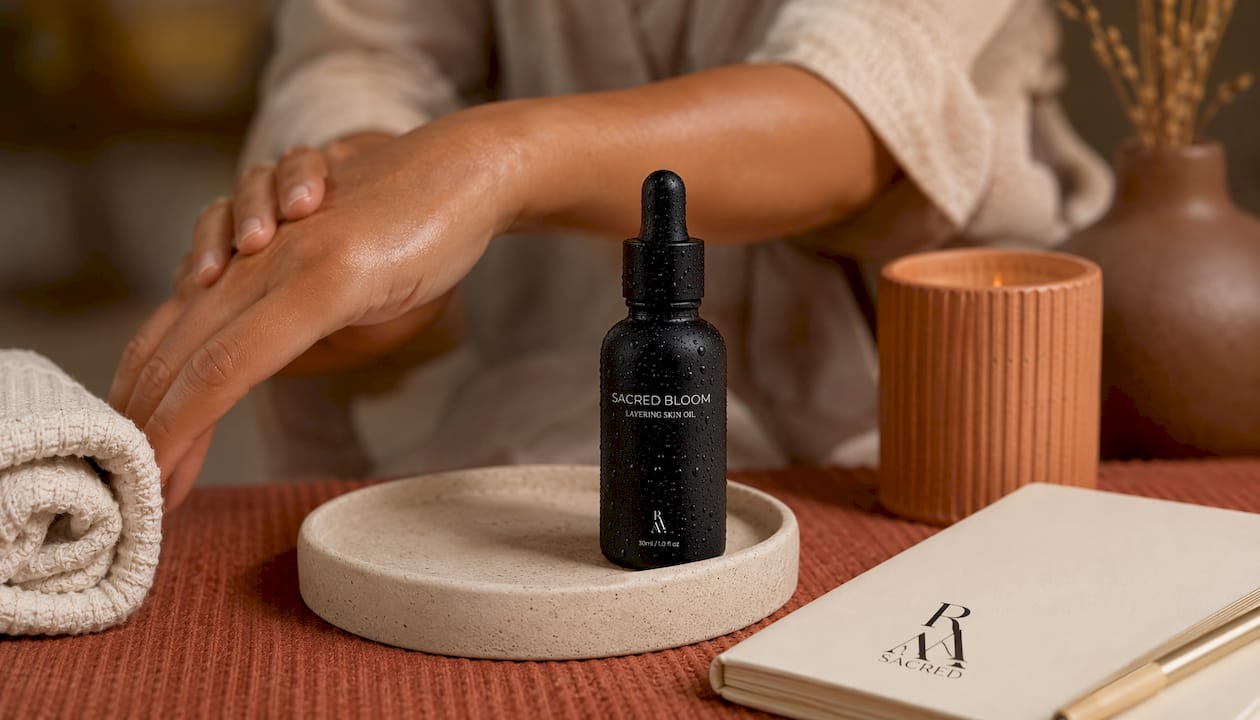
What to look for in a pre-blended massage oil: proper dilution already done for you, a non-greasy carrier that absorbs without leaving residue, and a scent profile simple enough to be calming rather than overwhelming. Raasacred’s Sacred Bloom is a 30ml skin-layering oil formulated for topical ritual use and daily nourishment. It’s built for exactly the kind of 5–15 minute self-massage routine described in this article: warm a few drops in your palms, apply with slow effleurage strokes, and let the blend do the work. Store it upright, away from direct sunlight, and it stays fresh for your daily ritual. To explore the full range of botanical body care that supports a consistent home practice, visit the Raasacred site and find the routine that fits your day.
Useful sources and further reading
These are the most authoritative sources cited throughout this article, useful if you want to go deeper on any specific topic.
- NCBI Bookshelf: Aromatherapy and Essential Oils — A Map of the Evidence — A broad evidence review covering 26 systematic reviews across multiple health conditions; the most comprehensive summary of what aromatherapy does and doesn’t have clinical support for.
- Cleveland Clinic: What Is Aromatherapy? — Clear, accessible explanation of olfactory and dermal mechanisms; good starting point for understanding how essential oils interact with the body.
- Johns Hopkins Medicine: Aromatherapy — Do Essential Oils Really Work? — Covers dilution guidance and safety considerations with authoritative clinical framing.
- NCCIH: Aromatherapy — The U.S. National Center for Complementary and Integrative Health’s overview; reliable for understanding the complementary-care positioning of aromatherapy.
- PubMed: Self-Massage Techniques for Pain and Mobility — Peer-reviewed review of self-massage efficacy for range of motion, pain, and muscle recovery; the strongest academic source on self-administered technique.
- UMMS Self-Massage Guide — Practical, practitioner-developed guide covering stroke technique, tool use, warming oil, and safety cues for home practice.